
Email marketing in Kenya is one of the most underused growth channels for small and medium businesses, and also one of the most consistently profitable. While most Kenyan SMEs pour their marketing energy into WhatsApp, Instagram, and Facebook, email quietly delivers returns that no social media platform comes close to matching. For every dollar spent on email marketing globally, the average return is between KES 4,600 and KES 5,400 based on the current exchange rate, making it the highest-ROI digital marketing channel available to any business owner in 2026.
This guide covers exactly how email marketing in Kenya works, which tools to use, how to build a list from scratch, and what types of campaigns actually convert in the Kenyan market. It fits naturally alongside your broader digital strategy. If you are also investing in social media, our guide on social media marketing in Kenya shows how the two channels work together. And if you want to understand how email fits into a wider system for growing your business online, our digital marketing in Kenya guide covers the full picture.

Why Email Marketing in Kenya Still Outperforms Every Other Channel
The common assumption among Kenyan business owners is that email is for large corporates and that WhatsApp or Instagram is where real business happens. The data tells a different story. Email marketing drives conversion rates of around 4.24 percent globally, compared to just 0.59 percent for social media, meaning email converts visitors into customers at roughly seven times the rate of any social platform. A well-planned email marketing strategy Kenya businesses invest in consistently is one of the few marketing channels where you own the entire relationship, independent of any algorithm or paid visibility requirement.
Kenya had 23.4 million internet users as of late 2025 according to DataReportal, and that number is expected to exceed 39 million by 2028. As more Kenyans come online, the opportunity for email marketing in Kenya grows with them. For B2B businesses in Kenya in particular, email is still the primary professional communication channel, reaching corporate employees, government officers, healthcare professionals, school administrators, and B2B buyers across Nairobi, Mombasa, Kisumu, and Nakuru in a way that TikTok or even Facebook cannot match.
Key fact: Email marketing Kenya businesses can access delivers an average global ROI of USD 36 to USD 42 for every USD 1 spent, according to Litmus and DMA 2026 data. Automated emails drive 37 percent of all email-generated sales despite making up only 2 percent of total sends, and 50 percent of consumers made a direct purchase from a marketing email in the past year.
How to Start Email Marketing in Kenya: Step by Step
Choose the Right Email Marketing Tool
When evaluating email marketing tools Kenya SMEs can realistically use, Brevo and MailerLite are the two most practical starting points. Brevo’s free plan includes up to 100,000 contacts and 9,000 emails per month, making it the most generous free option available. MailerLite’s free plan covers up to 1,000 subscribers and 12,000 emails per month with access to automation and landing pages. Both tools are accessible from Kenya using a Visa, Mastercard, or M-Pesa-funded virtual card for paid plans, and both have drag-and-drop editors that require no technical knowledge. Mailchimp is widely known but has significantly reduced its free plan in 2026, making it a less practical choice for email marketing Kenya businesses starting from scratch.
Build Your Email List the Right Way
The single most important rule of email list Kenya businesses should follow is never to buy an email list. Purchased lists produce low open rates, trigger spam filters, and can get your sending domain blacklisted, meaning future emails from your real customers will stop arriving. Instead, build your email list Kenya subscribers genuinely want to be on by using a signup form embedded on your website, a lead magnet such as a discount code or free guide, a WhatsApp broadcast that invites followers to subscribe, and a physical signup sheet at your premises or events. A well-run Nairobi retail business can realistically build a list of 500 to 1,000 genuine subscribers within three months using these methods consistently.
Set Up a Welcome Email Sequence
The moment someone signs up to your list is when they are most interested in your business. A welcome email sequence, typically two to three emails sent over the first week, introduces your brand, delivers any promised lead magnet, and gives the subscriber a clear reason to keep reading your emails. This is the single highest-return automation any business running email marketing in Kenya can set up. Both Brevo and MailerLite support welcome sequences on their free plans, meaning you can automate this for zero cost. Businesses that run a welcome sequence see significantly higher engagement across every subsequent campaign they send.
Write Subject Lines That Get Opened
A good open rate for any email campaign Kenya businesses send typically falls between 20 and 30 percent. The subject line is the single biggest lever you can pull to hit or exceed that range. Keep subject lines under 50 characters so they display fully on a mobile screen. Personalise with the subscriber’s first name where your tool supports it. Lead with a specific benefit or a curiosity gap rather than a generic update. Avoid spam trigger words like “FREE!!!” in all caps. And always test at least two subject line variations using A/B testing, which both Brevo and MailerLite offer even on free or low-cost plans.
Design for Mobile First
With roughly 70 percent of Kenyan web traffic arriving on mobile, most of your email subscribers will open your email marketing in Kenya campaigns on a smartphone. This means single-column layouts, large readable fonts, buttons that are easy to tap with a thumb, and images that load fast on a mobile data connection. Both Brevo and MailerLite automatically generate mobile-responsive email designs from their templates, so this is largely handled for you if you use the built-in builders rather than coding from scratch. Always preview the mobile version of your email before sending.
Segment Your List for Better Results
Sending the same email to your entire email list Kenya subscribers are on is the fastest way to accumulate unsubscribes. Segmentation, which means grouping your subscribers by location, buying behaviour, industry, or how they joined your list, lets you send more relevant messages to each group. A Nairobi-based distributor, for example, might send product restocking alerts only to wholesale buyers, and promotional discount emails only to retail customers. Segmented email marketing Kenya campaigns consistently generate higher click-through rates and fewer spam complaints than unsegmented broadcasts, regardless of which tool you use.
Track, Test, and Improve Every Campaign
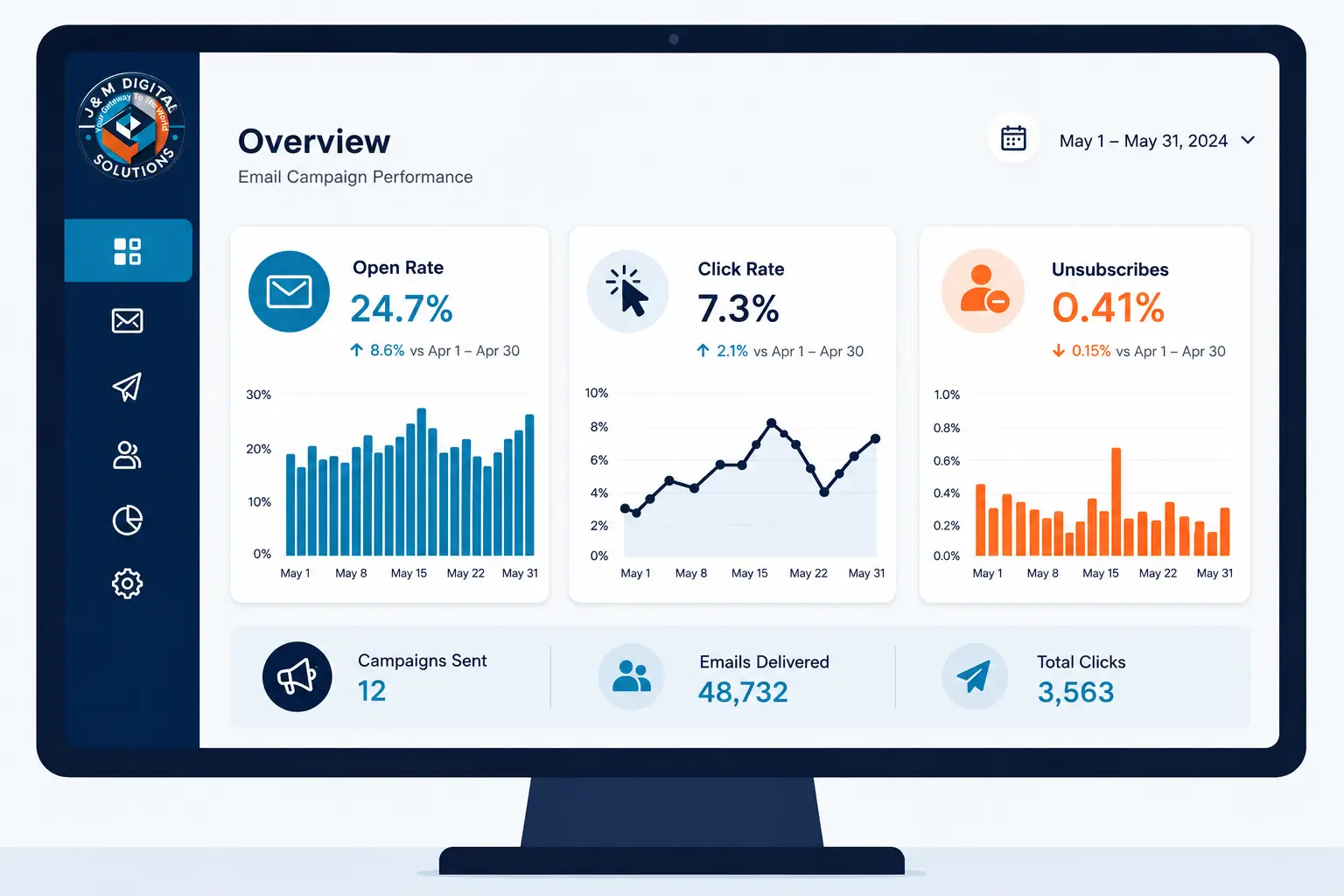
The minimum metrics to track for any email campaign Kenya businesses should monitor are your open rate, click-through rate, and unsubscribe rate. A falling open rate usually means your subject lines need work or your send frequency is too high. A low click-through rate means your email content is not matching what subscribers expected when they signed up. A rising unsubscribe rate is the clearest signal that something is wrong with either the relevance or the frequency of your sends. A strong email marketing strategy Kenya businesses can build on treats every campaign as a data point, and email marketing in Kenya rewards businesses that improve over time rather than firing and forgetting each broadcast.
Email Marketing Tools Compared for Kenyan Businesses
Choosing the wrong email marketing tools Kenya SMEs rely on is one of the most common reasons campaigns stall before they gain momentum. The table below compares the four most relevant platforms for Kenyan SMEs, based on free plan generosity, ease of use, and practical accessibility from Kenya. For broader context on how email fits alongside paid digital channels, our guide on Meta Ads in Kenya covers how to use the two together for maximum reach.
| Tool | Free Plan | Paid Plan From | Best For |
|---|---|---|---|
| Brevo | 100,000 contacts, 9,000 emails/month, 300/day | USD 9/month (approx. KES 1,170) | SMEs with large contact lists who send occasional campaigns |
| MailerLite | 1,000 subscribers, 12,000 emails/month, automation included | USD 12/month (approx. KES 1,560) | Beginners who want automation and landing pages from day one |
| Mailchimp | 500 contacts, 1,000 emails/month (significantly reduced in 2026) | USD 13/month | Businesses already integrated with Shopify or other Mailchimp partners |
| Zoho Campaigns | 2,000 contacts, 6,000 emails/month | USD 3/month | Businesses already using Zoho CRM or Zoho Books in their operations |
Case Study: A Mombasa E-Commerce Brand Builds Its Email Channel
Client: Online fashion and accessories retailer, Mombasa
The business had around 2,400 existing customer WhatsApp contacts but no email list and no system for re-engaging past buyers. Most of their marketing budget was going into Meta Ads with inconsistent returns, and they had no way to reach customers without paying for ad impressions every time.
We integrated MailerLite with their WooCommerce store, set up a three-part welcome sequence triggered on signup, and ran a WhatsApp broadcast inviting existing contacts to subscribe via a KES 200 discount code. Within 60 days the list was live and performing.
These results reflect one client in one industry over a specific 60-day window and are not a guarantee of outcomes for every business running email marketing in Kenya. Your results will depend on the strength of your offer, the quality of your list-building strategy, and how consistently you send relevant, useful content.
Types of Email Campaigns That Work in Kenya
A strong email marketing strategy Kenya businesses can sustain depends on rotating between the right campaign types at the right frequency. Not every email campaign Kenya businesses run will suit every situation. The table below maps common campaign types to the business situations where they perform best.
| Campaign Type | Best Used For | Frequency |
|---|---|---|
| Welcome sequence | Converting new subscribers into first-time buyers; setting expectations for your list | Automated, triggered on signup |
| Promotional email | Sales, seasonal offers, new product launches, end-of-month pushes | One to two times per month maximum |
| Newsletter | Building trust and top-of-mind awareness; positioning your business as a resource | Once or twice per month |
| Re-engagement email | Winning back subscribers who have not opened an email in 60 to 90 days | Quarterly for cold segments |
| Transactional email | Order confirmations, booking reminders, payment receipts for e-commerce or service businesses | Automated, triggered by purchase or booking |
How J&M Digital Solutions Can Help
Email marketing in Kenya delivers its best results when it is connected to a fast, well-structured website that captures signups, and supported by a broader digital strategy that drives traffic to your list. We help Kenyan businesses choose the right email marketing tools Kenya SMEs can actually manage, set up their email foundation from scratch, and integrate it into everything else they are doing online.
- Email platform setup and integration with your site via our web design services in Kenya
- Full digital marketing strategy including email via our digital marketing services
- Social media to grow your list via our social media marketing services
- SEO to drive organic traffic to your signup pages via SEO services in Kenya
- WhatsApp broadcast strategy to cross-promote your list via our WhatsApp Business in Kenya guide
Ready to Start Email Marketing in Kenya for Your Business?
Talk to us about building a proper email marketing in Kenya strategy for your business. We will help you choose the right tool, set up your first automation, and connect everything to your website so every visitor becomes a potential subscriber.
Phone / WhatsApp: +254 769 604 780 | Website: jmdigitalsolutionske.com | Service Area: Nairobi and Nationwide, Kenya
Frequently Asked Questions
Is email marketing in Kenya still effective in 2026?
Yes. Email marketing in Kenya remains one of the highest-return digital channels available to businesses of any size. It delivers an average global ROI of USD 36 to USD 42 for every USD 1 spent, converts at seven times the rate of social media, and reaches customers directly without depending on any algorithm or paid reach. For B2B businesses in Kenya in particular, email is still the primary professional communication channel.
What is the best free email marketing tool for Kenyan businesses?
Brevo is the most generous free option for email marketing in Kenya, offering up to 100,000 contacts and 9,000 emails per month on its free plan with no credit card required. MailerLite is the better choice if you want automation and landing pages included from day one, with a free plan covering up to 1,000 subscribers and 12,000 emails per month. Both tools are accessible from Kenya and accept international card payments or M-Pesa-funded virtual cards for paid plans.
How do I build an email list in Kenya?
The most effective list-building methods for email marketing in Kenya are embedding a signup form with a clear incentive on your website, running a WhatsApp broadcast that invites your existing contacts to subscribe, offering a discount code or free resource in exchange for an email address, and collecting emails at physical events or your premises. Never purchase an email list. Purchased lists produce poor results, damage your sender reputation, and can get your sending domain permanently blacklisted.
How often should I send emails to my Kenyan subscribers?
For most Kenyan small businesses, one to two emails per month is the right starting frequency. This is enough to stay top of mind without burning out your list. Once you have data on open rates and engagement, you can test increasing frequency. The optimal sending frequency depends heavily on your industry and what your subscribers signed up expecting to receive.
Can I use email marketing alongside WhatsApp for my Kenyan business?
Absolutely, and the two channels work well together. WhatsApp is best for quick, conversational, real-time communication, while email is better for longer content, formal communication, promotional campaigns, and reaching professional and B2B buyers. Many Kenyan businesses use WhatsApp broadcasts to invite followers to join their email list, and use email campaigns to drive traffic back to their WhatsApp for direct enquiries. The two channels complement each other rather than compete.