
Business card design in Kenya still matters, even with WhatsApp and Instagram doing so much of the selling. A good card is what you leave behind after a site visit, a client meeting, a trade fair or a chama, and it tells people in a few seconds whether your business looks established. A poorly printed card with a blurry logo does the opposite.
This guide covers what business card design in Kenya costs in 2026, the standard business card size and file setup, what to put on a card, paper and finish options, and how to avoid the printing mistakes we see most often. If you are still working on your logo, start with our guide to logo design cost in Kenya.

Why Business Cards Still Work in Kenya
Many deals in Kenya still start face to face, which is why business card design in Kenya is still worth getting right. Contractors, property agents, interior designers, lawyers, consultants and suppliers meet clients on site, at events and in offices, and a card is the quickest way to hand over a phone number that is spelt correctly. It also survives long after a WhatsApp chat has been buried under newer messages.
A well-designed card also does a quieter job: it makes a small business look as professional as a bigger one. When it matches your logo, website and social media, it builds the kind of consistency that makes customers trust you.
How Much Does Business Card Design in Kenya Cost?
The total cost of business card design in Kenya has two parts: the design and the printing. Many printers offer a quick design for a small fee, while agencies and designers charge more for a card designed around your brand.
| Item | Typical Price (KES) | What to Expect |
|---|---|---|
| Printer’s in-house design | Small fee, often added to the print order | Quick layout from a template; limited revisions |
| Business card design with a full brand package | Included in our Business package at 15,000 | Logo, colour and font guide, 10 social media designs and a business card, with print-ready files |
| Standard printing, single-sided | About 1,200 per 100 cards | 300gsm card, laminated |
| Standard printing, double-sided | About 1,400 per 100 cards | 300gsm card, laminated both sides |
| Bulk printing (1,000 cards) | About 7 to 11 per card | Price per card drops as quantity rises |
| Premium finishes | Extra | Spot UV, embossing, thick 600gsm card or rounded corners |
Printing prices above are from a published Nairobi printer’s price list (Printshop Kenya), which includes VAT; other printers advertise from about KES 7 to 10 per card on large orders. Rush printing within 24 hours usually costs extra. Always ask for a printed proof or a sample before a large run.
Tip: With business card design in Kenya, the design is the part you pay for once. A good file can be reprinted for years at any printer, so it is worth getting right before you think about the print price.
Standard Business Card Size and File Setup
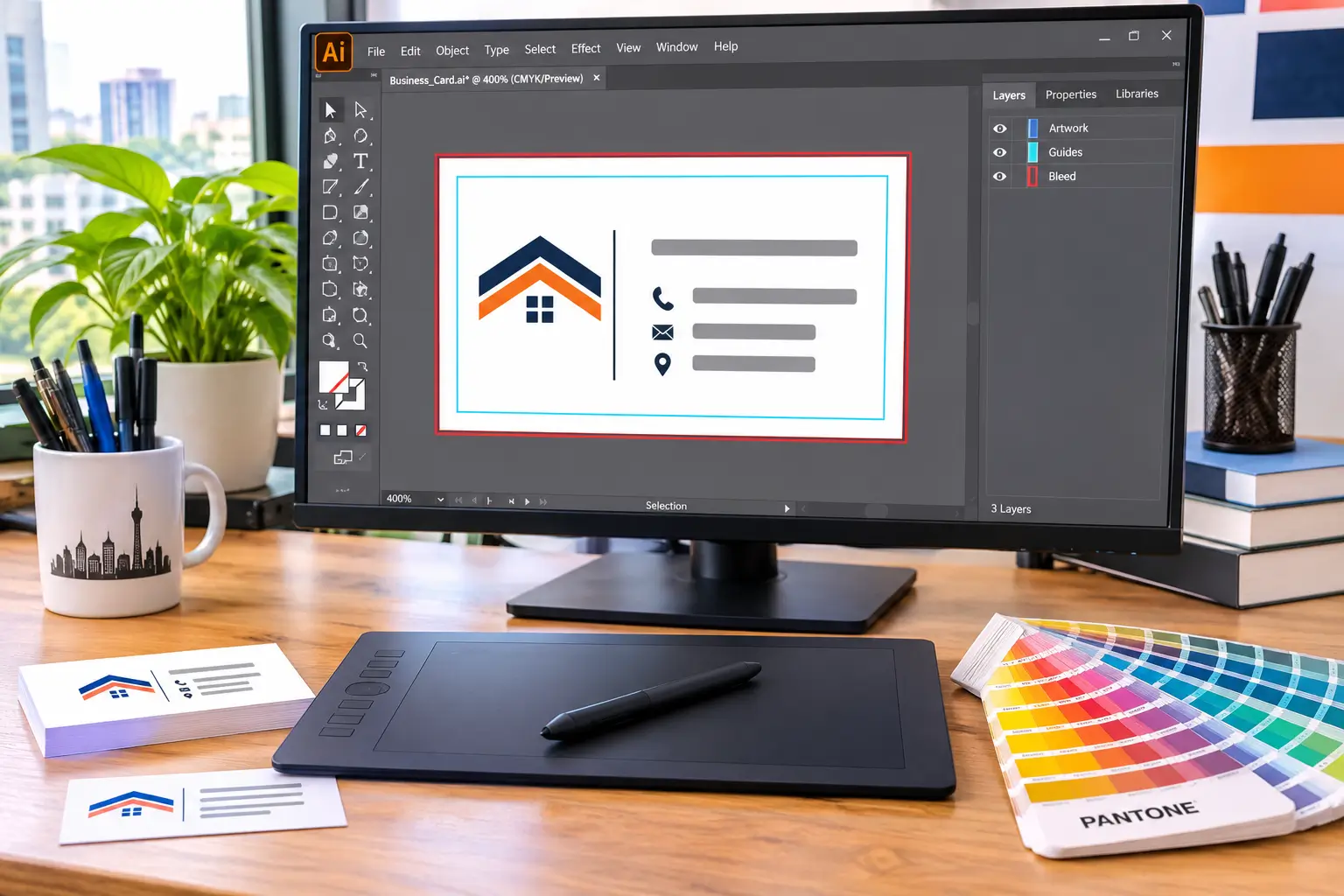
The business card size most Kenyan printers use is 85 × 55 mm, close to the size of an ATM card, so it fits standard card holders and wallets. Before you start business card design in Kenya, confirm your printer’s exact size, because a few use 90 × 55 mm or 90 × 50 mm.
| Setting | Recommended | Why It Matters |
|---|---|---|
| Trim size | 85 × 55 mm | The final size after cutting |
| Bleed | 3 mm on every side (91 × 61 mm artwork) | Stops white edges if the cut is slightly off |
| Safe zone | Keep text 4 to 5 mm inside the trim line | Protects names and numbers from being cut |
| Resolution | 300 dpi | Keeps logos and photos sharp |
| Colour mode | CMYK | Printers use CMYK; RGB colours can print duller |
| File format | Print-ready PDF with fonts embedded | Prevents font swaps and layout shifts |
What to Put on a Business Card
The best cards say less, not more. Include only what someone needs to remember you and contact you:
- Logo and business name: the most prominent element, usually on the front.
- Your name and job title: so people know who they met.
- Phone and WhatsApp number: in the format customers will dial, such as +254 7XX XXX XXX.
- Email and website: an email on your own domain looks far more credible than a free address.
- Location: a building, road or town is enough; full postal addresses are rarely needed now.
- A QR code: optional, linking to your website, WhatsApp chat or Google Business Profile.
- One line about what you do: useful if your business name does not explain it.
Skip long service lists and small print. If the card feels crowded, move details to the back of a double-sided business card or to your website.
Business Card Design Tips That Make a Card Look Professional
These six rules separate good business card design in Kenya from cards that end up in a drawer.
Start With Your Brand
Use your logo, brand colours and fonts exactly as they appear on your website and signage. A card that looks different from everything else weakens your brand rather than building it. Our brand identity guidelines post explains how to set these up.
Keep Text Large Enough to Read
Names and phone numbers should be at least 8 to 9 points. Small, thin fonts look elegant on screen but disappear on printed card, especially in dim light.
Use White Space
A minimalist business card with plenty of space around the logo looks more confident than one filled edge to edge. Space also makes the contact details easier to find.
Use Both Sides
A double-sided business card costs only a little more to print. Put the logo on the front and the contact details on the back, so each side stays clean.
Test the QR Code
If you add a QR code, print a test copy and scan it with two or three phones. Keep it at least 2 cm wide, with a plain background around it.
Proofread Everything Twice
Check every digit of the phone number and every letter of the email. One wrong digit makes a whole box of cards useless.
Paper and Finish Options
The paper and finish change how a card feels in the hand, and they are a big part of business card design in Kenya because printers here offer a wide range at different prices.
| Option | What It Looks Like | Best For |
|---|---|---|
| 300 to 350gsm card | Standard thickness, firm in the hand | Most businesses |
| Matte lamination | Smooth, soft, no glare | Professional services, minimalist designs |
| Gloss lamination | Shiny, colours look brighter | Colourful brands and photo-heavy designs |
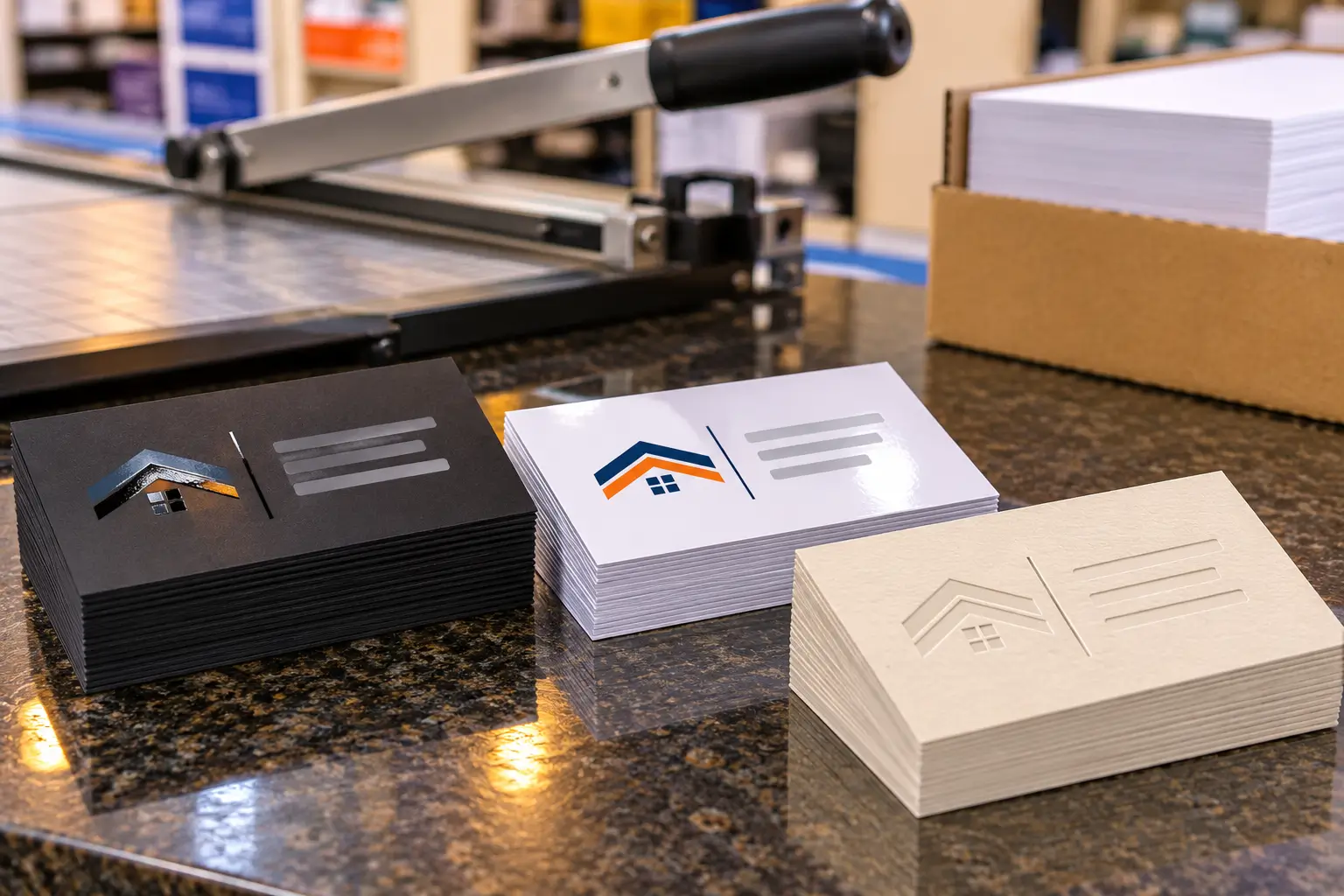
| Spot UV | A glossy raised layer on selected parts, such as the logo | Making the logo stand out on a matte card |
| Embossing | Raised logo or text you can feel | Premium and luxury brands |
| Thick 600gsm card | Noticeably heavier and stiffer | Executives, real estate and high-end services |
| Rounded corners | Softer, modern shape | Creative and lifestyle brands |
For most small businesses, a 350gsm card with matte lamination and spot UV on the logo gives a premium feel without a premium price.
Using a Canva Business Card Template
Many business owners start with a free business card template from Canva. That can work if you keep a few things in mind:
- Change the template enough: thousands of businesses use the same popular Canva business card designs, so customise the layout, colours and fonts to match your brand.
- Set the right size: create a custom design at 85 × 55 mm rather than using a template set to another country’s standard.
- Download correctly: choose “PDF Print”, tick “Crop marks and bleed”, and select CMYK if your plan offers it.
- Use a high-quality logo: upload a PNG or SVG file, never a screenshot from WhatsApp.
A template is a good start for a new business on a tight budget. Once you have a full brand, professional business card design in Kenya pays for itself in how your business is perceived.
Digital Business Cards and QR Codes
A digital business card is a mobile-friendly page with your contact details that people can save to their phone in one tap, usually shared by link or QR code. It is useful for events and online networking, and it never runs out. For most business card design in Kenya, the best approach is both: add a QR code to the printed card that opens your digital card, website or WhatsApp chat, and customers get both.
Common Business Card Printing Mistakes
Most problems with business card design in Kenya only show up after printing, when they are expensive to fix.
| Mistake | What Goes Wrong | How to Avoid It |
|---|---|---|
| No bleed | Thin white lines along the edges after cutting | Add 3 mm bleed on every side |
| Text too close to the edge | Names or numbers get trimmed | Keep text inside the safe zone |
| Low-resolution logo | Blurry or pixelated print | Use a vector or 300 dpi logo file |
| Designing in RGB | Colours print darker or duller than on screen | Convert to CMYK and request a proof |
| Wrong phone number or email | The whole print run is wasted | Proofread twice and call the number |
| Too much information | Cluttered, hard to read | Keep only essentials; use both sides |
Business Card Design in Kenya by Industry
The right style depends on what you do. A few examples from the sectors we work with:
- Real estate and property agents: thick card, a QR code to listings, and a clear WhatsApp number for site visit bookings.
- Interior design and construction: a clean layout with a strong brand colour; a project photo on the back works well.
- Lawyers, accountants and consultants: a minimalist business card on matte stock, with name, title and qualifications.
- Salons, spas and boutiques: bolder colours, rounded corners and the Instagram handle that customers actually follow.
- Engineering and technical services: clear service lines and an emergency or call-out number.
Whatever your sector, business card design in Kenya works best when the card looks like it belongs to the same family as your website, vehicle branding and social media posts.
How J&M Digital Solutions Can Help
We handle business card design in Kenya as part of a complete brand, so your card matches your logo, website and social media from day one.
- Custom card design built from your logo and brand colours
- Print-ready PDF files with bleed, crop marks and CMYK colour
- QR codes linked to your website, WhatsApp or Google Business Profile
- Matching posters and flyers for print and social media
- Matching company profiles and brochures
- Local design support through our Nairobi and Kiambu graphic design services
- Matching social media designs through our social media design service
- Full packages through our graphic design services in Kenya, with examples in our portfolio
Need a Business Card That Looks the Part?
Send us your logo, or tell us about your business, and we will design a card that matches your brand and is ready for any printer.
Phone / WhatsApp: +254 769 604 780 | Website: jmdigitalsolutionske.com | Service Area: Nairobi and Nationwide, Kenya
Frequently Asked Questions
How much does business card design in Kenya cost?
Printers often add a quick template design for a small fee, while agencies charge more for a card designed around your brand. Our Business package at KES 15,000 includes a business card with your logo, brand guide and social media designs. Printing typically costs about KES 1,200 to 1,400 per 100 cards.
What is the standard business card size in Kenya?
Most Kenyan printers use 85 × 55 mm. Add 3 mm bleed on every side, so your artwork measures 91 × 61 mm.
What paper is best for business cards?
A 300 to 350gsm card with matte or gloss lamination suits most businesses. Thicker 600gsm card, spot UV or embossing gives a more premium feel.
Can I design my own business card on Canva?
Yes. Set a custom size of 85 × 55 mm, customise the template to your brand, and download as “PDF Print” with crop marks and bleed.
Should I put a QR code on my business card?
A QR code is useful if it links somewhere helpful, such as your website, WhatsApp chat or Google Business Profile. Test it on several phones before printing.