
Kenya is one of the fastest growing e-commerce markets in Africa. With a gross merchandise value projected to reach KES 490 billion by 2028, a mobile-first population of over 22 million internet users, and M-Pesa making it possible for anyone with a phone to pay instantly, the conditions for selling products online in Kenya have never been better. Yet most Kenyan small business owners still rely entirely on walk-in customers, WhatsApp DMs, or Instagram posts with no real system for capturing and converting online orders at scale.
This guide covers everything a Kenyan business owner needs to know about e-commerce in Kenya in 2026: which platform to use, how to set up an online store, how to accept M-Pesa payments, how to handle delivery, and how to drive traffic to your store so it generates consistent sales every month.
For more on growing your business online, read our guides on WhatsApp Business in Kenya, Google Business Profile in Kenya, and How to Start an Online Business in Kenya.

Why E-Commerce in Kenya Is a Major Opportunity in 2026
Kenya ranks third in e-commerce market penetration across the entire African continent, behind only Egypt and South Africa. The country’s e-commerce gross merchandise value grew from USD 2.3 billion in 2023 to USD 2.6 billion in 2024, with projections pointing to USD 3.8 billion by 2028. These are not abstract numbers. They represent Kenyan consumers who are actively choosing to buy online rather than in person, and the shift is accelerating rapidly with every passing year.
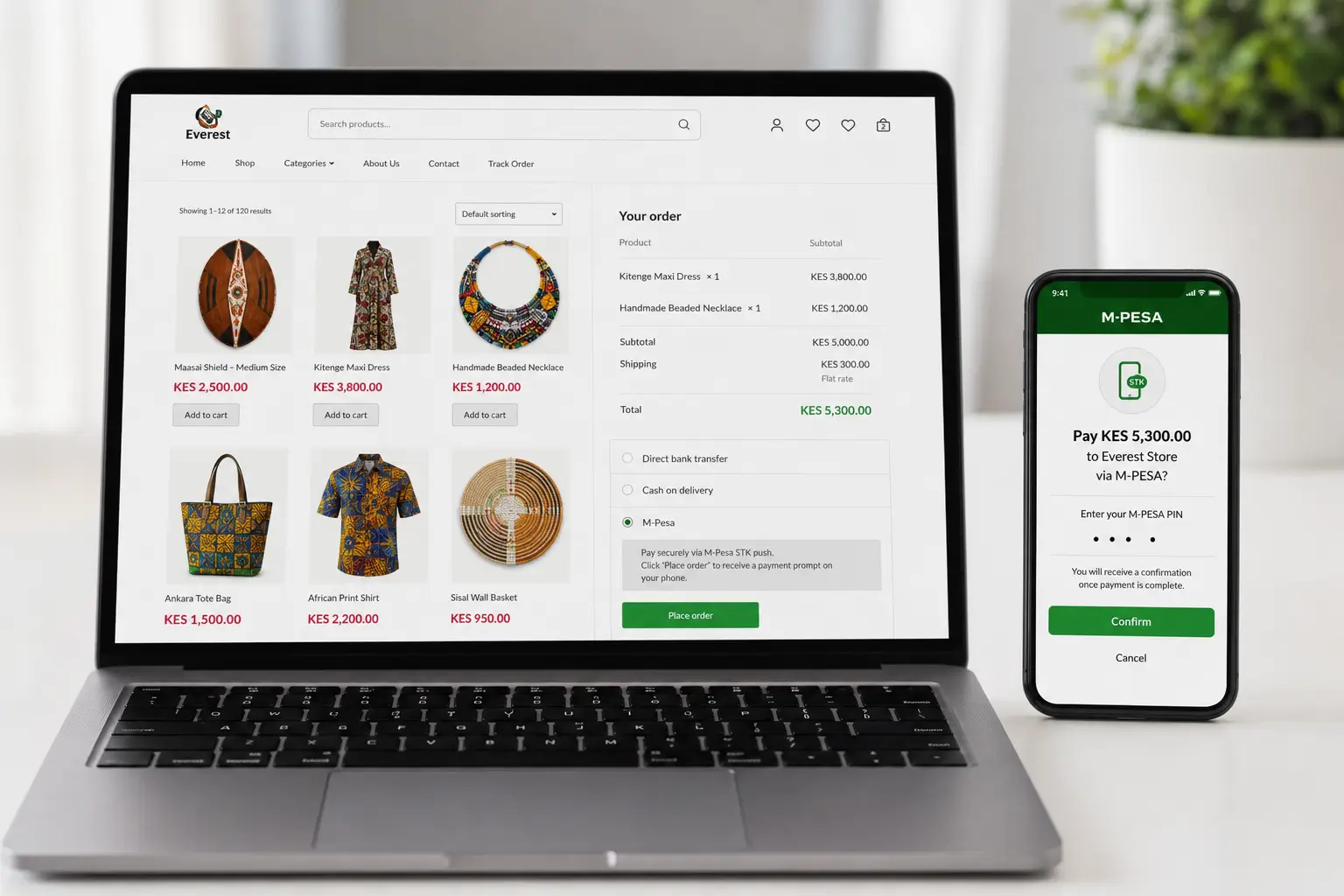
What makes e-commerce in Kenya different from other markets is the infrastructure already in place. M-Pesa has over 30 million active users in Kenya, meaning the payment friction that cripples e-commerce adoption in other African countries simply does not exist here. A customer in Eldoret, Kisumu, or Mombasa can discover your product online, pay via M-Pesa STK push, and receive their order within two to four days. That full buying journey, from discovery to delivery, is now available to any Kenyan business willing to set it up correctly.
Key fact: Rural Kenya now drives 60 percent of all Jumia orders in the country, according to Jumia’s 2025 e-commerce report. This means e-commerce in Kenya is no longer a Nairobi phenomenon. Customers across all 47 counties are buying online, and businesses that set up online stores are accessing a national market, not just their local area. The average delivery time for rural Kenyan shoppers has dropped to two to four days as logistics networks expand.
Which E-Commerce Platform Is Right for Your Kenyan Business?
The most important decision you will make when starting e-commerce in Kenya is which platform to build your store on. The right choice depends on your budget, your technical ability, your product type, and your long-term growth ambitions. There is no single correct answer, but there is a correct answer for your specific situation.
| Platform | Best for | Setup cost (KES) | M-Pesa support | Monthly cost (KES) |
|---|---|---|---|---|
| WooCommerce | Growing businesses wanting full control and the best long-term value | 60,000 to 100,000 (professional setup) | Yes, via Pesapal, Flutterwave, or direct Daraja API | 2,000 to 5,000 (hosting only) |
| Shopify | Businesses wanting fast launch with no technical skill required | Minimal (template-based) | Yes, via Pesapal or Paystack | 4,000 to 13,000 (platform fee) |
| Jumia / Kilimall | Businesses wanting instant access to an existing customer base | Free to list | Handled by the marketplace | 15 to 20% commission per sale |
| Instagram Shopping | Businesses already selling via DMs wanting to formalise WhatsApp and Instagram sales | Free | Manual via WhatsApp payment confirmation | Free |
For most Kenyan small and medium businesses planning to grow seriously, WooCommerce on WordPress is the recommended foundation for e-commerce in Kenya. It gives you full ownership of your store, your customer data, and your brand experience. It integrates natively with M-Pesa through several reliable payment gateways. And because it sits on your own WordPress website, every product page you create also builds your SEO presence, bringing you organic traffic from Google over time without ongoing ad spend. See our e-commerce website design in Kenya page to see how we build WooCommerce stores for Kenyan businesses from the ground up, and our WordPress website design in Kenya page if you are starting with a brand new WordPress site before adding your store.
How to Start E-Commerce in Kenya: Step by Step
Choose your products and validate demand
Before building anything, confirm there is real demand for what you want to sell online. Search for your product on Google Kenya, Jumia, and TikTok to see how many competing sellers exist and how actively customers are searching. The strongest products for e-commerce in Kenya are those with consistent demand, reasonable delivery weight, good margins after shipping costs, and a clear differentiator from what is already available on major marketplaces. Start with three to five products rather than listing everything at once, so you can learn what converts before scaling your catalogue.
Register your business and get an M-Pesa till or paybill
A legitimate online business in Kenya needs a registered entity and a dedicated M-Pesa business number. Register your business with the Business Registration Service (BRS) at Huduma Centre or online at ecitizen.go.ke. Then apply for an M-Pesa till number (for retail point of sale payments) or a paybill number (for online store integrations) through your bank or a licensed aggregator such as Pesapal or Flutterwave. Your paybill or till number is what connects directly to your WooCommerce or Shopify store checkout, allowing customers to pay via M-Pesa STK push instantly during checkout without leaving your website.
Build your online store
Set up your e-commerce website with a domain name that reflects your brand (ideally a .co.ke or .com), reliable Kenyan hosting, and your chosen e-commerce platform. For WooCommerce, install WordPress, add the WooCommerce plugin, choose a clean mobile-responsive theme, and begin adding your products with professional photos, clear descriptions, prices in KES, and accurate stock levels. Mobile optimisation is not optional for e-commerce in Kenya: over 70 percent of Kenyan online shoppers browse and buy on their smartphones, so your store must load fast and be easy to navigate on a small screen. If you need a professionally built store without the technical setup headache, see our e-commerce website design in Kenya service page to see how we handle everything from hosting to M-Pesa integration for you.
Integrate M-Pesa payments
M-Pesa integration is the single most important technical step for any e-commerce business in Kenya. Kenyan customers expect to pay via M-Pesa at checkout. A store that only accepts card payments will lose a significant portion of its potential customers. The most reliable way to integrate M-Pesa into a WooCommerce store is through a payment gateway such as Pesapal, which supports both M-Pesa STK push and card payments through one integration. Pesapal sends the customer a payment prompt directly to their phone, they approve it with their M-Pesa PIN, and the payment confirms on your store automatically. The customer never has to leave the checkout page or manually enter a till number.
Set up delivery and fulfilment
Delivery is one of the biggest practical challenges in e-commerce in Kenya, and how you handle it will directly affect your customer reviews and repeat purchase rate. For Nairobi based businesses, same-day and next-day delivery is achievable through courier partners such as Sendy, Fargo, or G4S. For national delivery across Kenya’s 47 counties, Posta Kenya, Wells Fargo, and third-party logistics providers cover most towns with two to four day windows. Clearly display your delivery zones, costs, and timelines on your website before checkout so customers are never surprised. Offering free delivery above a minimum order threshold, such as KES 2,000 or KES 3,000, is one of the most effective ways to increase average order value in the Kenyan market.
Drive traffic to your store
An online store with no visitors generates no sales. The three most cost effective traffic channels for e-commerce in Kenya are search engine optimisation (getting your product pages ranked on Google Kenya for queries like “buy [product] Kenya” or “[product] price Kenya”), social media content on Instagram, Facebook, and TikTok that drives followers to your store link, and WhatsApp broadcast marketing to your existing customer list. Google SEO is the highest value long term channel because it generates free, high intent traffic from customers who are already searching for what you sell. Social media and WhatsApp generate faster initial results but require consistent ongoing effort. A business that invests in all three simultaneously builds the most resilient e-commerce traffic base in the long run. See our Instagram Marketing in Kenya guide for how to connect your social media content directly to your online store.
M-Pesa for E-Commerce in Kenya: What You Need to Know
M-Pesa is not just a payment option for e-commerce in Kenya. It is the baseline expectation. With over 30 million active users and over 51 million registered accounts, M-Pesa is how the vast majority of Kenyan consumers choose to pay for online purchases. Cart abandonment rates in Kenya sit at 90 to 91 percent for stores that do not offer a frictionless local payment option, which is significantly higher than the global average. Integrating M-Pesa properly is the single most impactful technical change any Kenyan e-commerce business can make to improve its conversion rate.
STK Push vs manual M-Pesa payments
There are two ways Kenyan e-commerce businesses handle M-Pesa payments. The manual method asks customers to send money to a till or paybill number and enter a reference code, then wait for an admin to confirm the payment before processing the order. This method is common among small WhatsApp-based sellers but creates friction, delays, and errors that cost sales. The automated STK push method, available through payment gateways like Pesapal and Flutterwave, sends the customer an automatic M-Pesa prompt on their phone the moment they confirm their order. They approve it with their PIN and the payment reflects on your store instantly, with no manual confirmation required. For any serious e-commerce business in Kenya, STK push integration is the standard to build toward.
Pro tip: Always display prices in Kenyan Shillings (KES) on your e-commerce store, never in USD or other currencies. Kenyan shoppers are significantly more likely to complete a purchase when they see a familiar currency and do not have to calculate a conversion. Displaying USD prices signals that your store is not designed for the Kenyan market and increases bounce rates and cart abandonment.
Real Result: How a Nairobi Home Decor Business Built an E-Commerce Store That Generates KES 280,000 in Monthly Online Sales
Client: Home decor and soft furnishings, Nairobi Karen
This client had been selling home decor products exclusively through Instagram DMs and a physical showroom for four years. Every order required multiple back and forth messages to confirm product availability, share M-Pesa payment details, and arrange delivery. She was spending three to four hours daily managing order conversations and losing potential customers who did not have the patience to wait for manual responses.
We built a WooCommerce e-commerce store for her with full M-Pesa STK push integration via Pesapal, a catalogue of 64 products with professional photography, a delivery calculator covering all Nairobi zones, and SEO-optimised product pages targeting searches like “home decor Nairobi” and “curtains Kenya.” Within 30 days of launch the store was receiving organic traffic from Google. By month three, the store was processing KES 280,000 in monthly online sales, with 68 percent of customers completing checkout without any manual intervention from her team. Order management time dropped from four hours daily to under 45 minutes.
Results vary depending on your product category, photography quality, and how actively you drive traffic to your store. This client had an established product range and strong Instagram following that gave the store an immediate source of initial traffic alongside organic Google growth.
Common E-Commerce Mistakes Kenyan Businesses Make
| Mistake | Why it hurts you | What to do instead |
|---|---|---|
| No M-Pesa integration | The majority of Kenyan customers prefer M-Pesa; a store without it loses most potential buyers at checkout | Integrate M-Pesa STK push via Pesapal or Flutterwave from day one |
| Poor product photography | Blurry or dark photos destroy trust and make products look lower quality than they are | Use natural light, a plain background, and multiple angles for every product; a smartphone camera is sufficient |
| No delivery information at checkout | Customers abandon carts when they cannot see delivery costs or timelines before paying | Display delivery zones, costs in KES, and estimated delivery days clearly on every product page and at checkout |
| Building a store and waiting for traffic | An online store with no active SEO or social media traffic strategy generates zero sales regardless of how good the products are | Start driving traffic from day one via Instagram, TikTok, WhatsApp broadcasts, and Google SEO simultaneously |
| Listing too many products before optimising | A large catalogue with poor descriptions and photos is less effective than a small catalogue done exceptionally well | Launch with your ten best-selling products, nail the photography and descriptions, then expand once those pages are converting |
| No follow-up system for abandoned carts | Kenya’s 90 percent cart abandonment rate means most interested customers leave without buying; no follow-up means permanently lost revenue | Set up automated abandoned cart emails or WhatsApp follow-ups through WooCommerce recovery tools or a CRM |
| Using prices in USD | Kenyan shoppers are significantly less likely to complete a purchase when prices are not shown in KES | Set your store currency to KES and display all prices in shillings at all times |

Using SEO to Drive Free Traffic to Your E-Commerce Store in Kenya
Paid advertising on Meta or Google can drive immediate traffic to your e-commerce store, but it stops the moment your budget runs out. Search engine optimisation builds traffic that grows over time and costs nothing per click once your pages are ranking. For e-commerce in Kenya, the most valuable SEO opportunity is ranking your individual product category and product pages for searches that Kenyan buyers are already typing into Google, such as “buy [product] Nairobi,” “[product] price Kenya,” or “best [product] Kenya 2026.”
Each product page on a WooCommerce store should have a unique title tag, a meta description that includes the product name and Kenya as a location signal, a detailed product description of at least 200 words written for the buyer rather than copied from a supplier, and a filename and alt text for every product image. Internal links between related product pages and your blog content reinforce your site’s authority in your category over time. A Kenyan e-commerce store that consistently produces blog content answering questions your target customers are searching for, combined with well-optimised product pages, builds a compounding SEO presence that becomes one of its most valuable business assets. Read our full guide on Social Media Marketing in Kenya to see how to connect your store’s SEO strategy with your social content.
How J&M Digital Solutions Builds E-Commerce Stores for Kenyan Businesses
At J&M Digital Solutions, we build complete e-commerce stores for Kenyan businesses on WooCommerce, from domain and hosting setup through to M-Pesa integration, product photography guidance, SEO optimisation, and connection to your WhatsApp Business and social media channels. A well-built e-commerce store is not just a catalogue of products. It is a 24-hour sales system that takes orders, confirms M-Pesa payments, and manages inventory automatically while you focus on sourcing, fulfilment, and growing your business.
- Custom e-commerce website design in Kenya on WooCommerce, built for M-Pesa, SEO, and mobile-first Kenyan shoppers
- Professional WordPress website design in Kenya as the foundation for your online store
- M-Pesa STK push integration via Pesapal or Flutterwave
- Product page creation with SEO-optimised titles, descriptions, and image alt text
- Delivery zone setup and shipping calculator configuration
- WhatsApp Business chat button integration on your store
- Ongoing SEO and content marketing to drive organic Google traffic to your products
Ready to Start Selling Online in Kenya?
J&M Digital Solutions builds professional e-commerce stores for Kenyan businesses with M-Pesa integration, SEO, and full digital marketing setup. Whether you are starting from scratch or upgrading from Instagram DM sales, we build the system that takes your business online and keeps it growing.
Phone / WhatsApp: +254 769 604 780
Website: jmdigitalsolutionske.com
Service area: Serving businesses across Kenya
Frequently Asked Questions
How much does it cost to start an e-commerce business in Kenya?
A professional WooCommerce e-commerce store in Kenya costs between KES 60,000 and KES 100,000 for a complete setup including domain, hosting, design, M-Pesa integration, and product page creation. Shopify is cheaper to start at roughly KES 4,000 to KES 13,000 per month but has ongoing platform fees that add up over time. If you are testing the market with limited budget, starting with Instagram Shopping or a WhatsApp Business catalogue costs nothing, though you sacrifice automation, SEO benefits, and professional credibility. For a business planning to sell seriously and scale, a WooCommerce store is the best long-term investment for e-commerce in Kenya.
How do I accept M-Pesa payments on my online store in Kenya?
The most reliable method for integrating M-Pesa into an e-commerce store in Kenya is through a payment gateway such as Pesapal or Flutterwave. These gateways connect your WooCommerce or Shopify store to M-Pesa’s Daraja API and send customers an STK push payment prompt on their phone at checkout. The customer approves the payment with their PIN and the confirmation reflects on your store automatically. You will need an M-Pesa paybill number, a business registration certificate, and a bank account to apply for a merchant account with these payment gateways.
Which products sell best on e-commerce in Kenya?
The strongest performing categories for e-commerce in Kenya based on current market data are fashion and clothing, electronics and smartphones, home decor and soft furnishings, beauty and personal care products, food and grocery items, and baby products. Travel and services also represent a significant share of online spending. The key is to choose a product category with consistent demand, manageable delivery logistics, and margins that can absorb shipping costs while remaining competitive on price. Niche products with limited availability in physical retail stores often perform exceptionally well online because the customer has no local alternative.
Do I need to register my business to sell online in Kenya?
Yes. Operating an e-commerce business in Kenya without formal registration creates legal and financial risks. You need a registered business name or company to open a business bank account, apply for an M-Pesa paybill or till number, sign up with payment gateways like Pesapal, and comply with Kenya Revenue Authority (KRA) tax obligations on digital sales. Business registration in Kenya costs as little as KES 950 for a sole proprietorship and can be completed online through the eCitizen portal. Registering your business also significantly increases customer trust, as buyers are more confident purchasing from a store with visible business credentials.
How do I drive traffic to my e-commerce store in Kenya?
The three most effective free traffic channels for e-commerce in Kenya are SEO (optimising your product pages to rank on Google for searches like “buy [product] Kenya”), social media content on Instagram, TikTok, and Facebook that drives followers to your store link, and WhatsApp broadcast messages to your existing customer base. For faster initial results, Google Shopping Ads and Meta product ads targeting Kenyan audiences can generate sales within days of launch. The strongest long-term strategy combines organic SEO for sustained free traffic with social media content for brand awareness and WhatsApp for repeat customer retention.