
On Page SEO in Kenya: The Complete Guide to Optimizing Your Website
If you want your business website to rank higher on Google, on page SEO in Kenya is where your journey must begin. It refers to everything you do directly on your website pages to make them more visible, more relevant, and more useful to both search engines and real users. Unlike off-page strategies that depend on external factors, this approach gives you direct control over your results from day one.
For businesses across Nairobi, Mombasa, Kisumu, and beyond, applying on page SEO in Kenya correctly can be the difference between a website sitting invisible on page five and one attracting steady leads every week. This guide walks you through every core element. For related topics, visit our SEO for Beginners Guide, Keyword Research Guide, Technical SEO Guide, and Local SEO Kenya Guide.

What Is On Page SEO? (A Clear Definition)
On page SEO in Kenya is the practice of optimizing individual pages on your website so Google can understand what each page is about and match it to relevant searches. It covers your page title, meta description, headings, body content, URLs, images, and internal links. Each of these signals tells Google more about your page, and the stronger those signals are, the better your chances of ranking well.
Effective website optimization is not just about inserting keywords. It is about creating a well-structured, genuinely useful page that satisfies the searcher’s intent. Google is very good at distinguishing helpful pages from those that simply repeat a phrase. Strong optimization balances technical requirements with readability, always placing the user’s needs at the center of every decision.
Pro Tip: Before optimizing any element, ask yourself: what is this person searching for, and how can my page answer their question better than competing pages? That mindset is the true foundation of on page SEO in Kenya.
Why It Matters for Businesses in Kenya
Kenya’s digital market is expanding fast. More consumers use Google to find businesses and make purchasing decisions before they ever call or visit in person. If your website is not optimized, you are leaving those customers for competitors to capture.
Website optimization is also the foundation of every other digital marketing effort. Strong backlinks and a well-maintained Google Business Profile lose much of their impact if your actual pages are poorly structured. On page SEO in Kenya also helps you compete without a massive budget — many Kenyan businesses still underinvest in this area, which means well-optimized pages can outrank much larger competitors simply by being more relevant and better organized.
The Core Elements of On Page SEO in Kenya
1. Title Tags
The title tag is one of the most critical signals in on page SEO in Kenya. It is the clickable headline that appears in Google results and should include your primary keyword naturally. Keep titles under 60 characters so they display in full, place the keyword near the beginning, and make the title compelling enough to earn clicks. Every page must have a unique title that clearly reflects its specific content — duplicate titles weaken your overall ranking signals.
2. Meta Descriptions
Meta descriptions do not directly determine rankings, but they influence how often users click on your result. For on page SEO in Kenya, write descriptions between 140 and 160 characters, include your keyword naturally, and add a clear call to action. Think of it as a short advertisement for your page — a well-crafted description boosts your click-through rate, which over time signals relevance to Google.
3. Heading Structure (H1, H2, H3)
Proper headings are essential to on page SEO in Kenya. Every page should have exactly one H1 as the main title, followed by H2 and H3 subheadings to organize sections. Headings help users scan content quickly and help Google understand your topic hierarchy. Including your keyword in the H1 and in some H2 headings reinforces relevance without over-optimizing.
4. Keyword Placement and Density
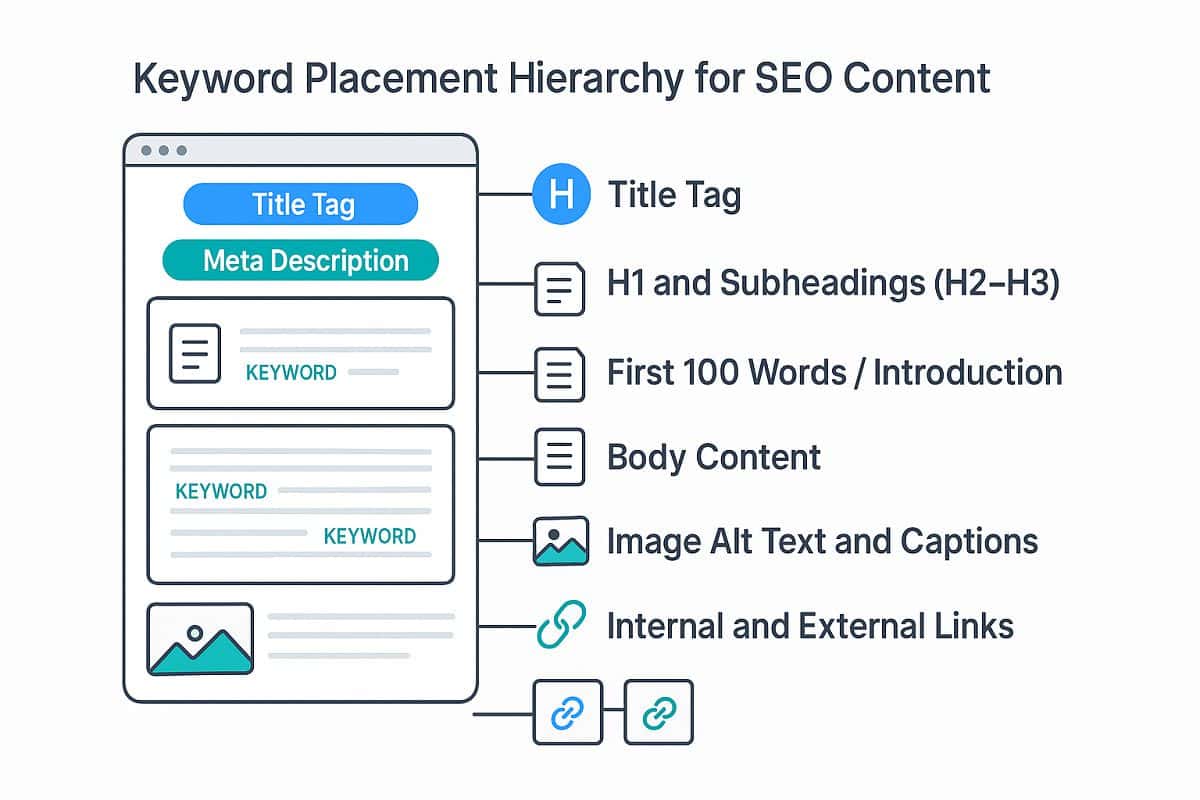
Where you place your keyword matters almost as much as which keyword you target. For on page SEO in Kenya, include your primary keyword in the H1, within the first 100 to 150 words of body content, in at least one or two subheadings, in image alt text, and in the URL. Aim for a natural density of around 1.5 percent. Always write for humans first — forced repetition hurts readability and can trigger over-optimization penalties from Google.
5. URL Structure
A clean URL is an often-overlooked signal in on page SEO in Kenya. Compare yourwebsite.com/p?id=482 with yourwebsite.com/on-page-seo-kenya — the second is far more useful to both Google and users. Use lowercase letters, separate words with hyphens, keep URLs short, and include your primary keyword where it fits naturally.
Content Quality: The Heart of Optimization
No single element matters more than the quality of your content. Google’s goal is to show users the most helpful and relevant page for any given query. If your content answers the user’s question better than competing pages, you have the strongest possible foundation for on page SEO in Kenya success.
Match Search Intent
Understanding search intent is essential to getting on page SEO in Kenya right. Every query falls into a category: informational (wanting to learn), navigational (looking for a specific site), transactional (ready to act), or commercial (comparing options before a decision). Match your content type and depth to the intent behind your target keyword. A service page targeting a transactional query should be focused on conversion, not just education.
Depth and Readability
Your content needs to be comprehensive enough to fully address the topic without unnecessary padding. Longer, well-structured content tends to earn more engagement and backlinks — but quality always outweighs word count. Use short paragraphs, clear subheadings, and plain language. In Kenya, where most users browse on mobile, well-formatted content is especially important for keeping visitors engaged long enough to take action.
Image Optimization for On Page SEO in Kenya
Images improve user experience but must be handled correctly to support on page SEO in Kenya. Use descriptive, keyword-relevant file names before uploading — a file named on-page-seo-kenya-guide.jpg signals far more than IMG_0042.jpg. Always add alt text that describes the image and naturally includes your keyword where relevant, as this supports both accessibility and search visibility.
Compress images before uploading to reduce file size without visible quality loss. Faster-loading images mean faster pages, and page speed is a direct Google ranking factor. Modern formats like WebP offer better compression with broad browser support. Image optimization is a small but valuable part of website optimization because it contributes to both speed and keyword signals simultaneously.
Important: Many businesses working on on page SEO in Kenya skip image optimization entirely. This is a missed opportunity — well-optimized images add meaningful keyword signals and improve load times, giving your pages an edge over less careful competitors.
Internal Linking Strategy
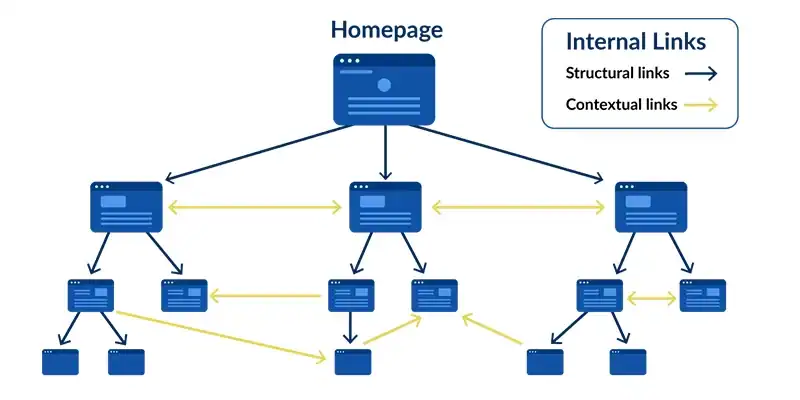
Internal linking is one of the most powerful and underused tools in on page SEO in Kenya. A well-placed internal link connects one page on your site to another, helping Google understand your site structure and distributing authority across your pages. Every page you publish should link to at least two or three other relevant pages using descriptive anchor text that includes relevant keywords — not generic phrases like “click here.”
For example, linking to your keyword research content using anchor text “keyword research in Kenya” tells Google exactly what the linked page covers. A strong internal linking approach also helps newer pages gain authority from older, more established ones — a consistent and effective practice in any serious on page SEO in Kenya strategy.
On Page SEO Checklist for Kenyan Businesses
| Element | What to Optimize | Why It Matters |
|---|---|---|
| Title Tag | Include keyword, under 60 characters, compelling copy | First signal Google reads; drives click-through rate |
| Meta Description | 140–160 characters, keyword included, call to action | Improves click-through rate from search results |
| H1 & Headings | One H1 per page, keyword in H1, logical H2/H3 structure | Clarifies content structure for Google and users |
| URL Structure | Short, descriptive, lowercase, keyword-included | Improves crawlability and user trust |
| Keyword Placement | First 150 words, headings, alt text, URL, body | Reinforces relevance signals across the page |
| Image Optimization | Descriptive file names, alt text, compressed, WebP | Improves speed, accessibility, and keyword signals |
| Internal Links | Descriptive anchor text linking to relevant pages | Distributes authority and supports navigation |
| Content Quality | Match intent, cover topic fully, format for mobile | Directly drives rankings and user engagement |
Common Mistakes to Avoid
Even well-intentioned businesses make mistakes that hold back their progress. Keyword stuffing — forcing the same phrase unnaturally into every paragraph — does not improve rankings. It triggers over-optimization penalties. Write naturally and let keyword placement flow within genuinely useful content.
Publishing thin pages with only 200 to 300 words rarely satisfies a user’s question, and Google knows it. Duplicate content — copying manufacturer descriptions or near-identical service pages — confuses Google about which version to rank. Finally, never treat on page SEO in Kenya as a set-and-forget task. Competitors update their content regularly, and revisiting your key pages every six to twelve months is essential for maintaining and growing your rankings over time.
How On Page SEO Connects to the Broader Strategy
On page SEO in Kenya works best as part of a complete strategy. Technical SEO provides the infrastructure — ensuring your site is fast, mobile-friendly, secure, and properly crawlable. Off-page SEO builds authority through backlinks and external signals. Your website content is the layer that makes each individual page competitive for a specific search query.
All three must work together for sustainable growth. For technical guidance, see our Technical SEO Guide. For authority building, read our SEO for Beginners Guide. For location-based visibility, visit our Local SEO Kenya Guide.
How We Help with On Page SEO in Kenya
At J&M Digital Solutions, we specialize in on page SEO in Kenya for businesses of all sizes. Our work covers comprehensive page audits, title and heading improvements, content optimization, image enhancement, and internal linking strategies. We understand the local market and structure content for the way Kenyan users actually search, giving your pages a clear advantage over less optimized competitors.

Why Choose J&M Digital Solutions
- Deep expertise in on page SEO in Kenya across all industries
- Proven results with real improvements in rankings and organic traffic
- Affordable packages designed for small businesses and startups in Kenya
- Full transparency with clear reporting on everything we do
- Comprehensive service covering titles, content, images, links, and structure
If your website is not generating the traffic and leads it should, the problem is often rooted in incomplete optimization. Let us identify the gaps, fix the issues, and build a stronger foundation for long-term growth.
Get Expert On Page SEO Services in Kenya
Ready to improve your Google rankings with proven on page SEO in Kenya strategies? J&M Digital Solutions is here to help your business attract more traffic, more leads, and more customers from search.
Phone / WhatsApp: +254 769 604 780
Website: jmdigitalsolutionske.com
Service Area: Serving businesses across Kenya
Final Thoughts
On page SEO in Kenya is one of the most practical and high-return investments you can make for your website. From crafting the right title tags and headings to optimizing images, building internal links, and writing content that genuinely serves your audience, every element plays a specific role in your ranking performance. Start with a review of your most important pages, apply the best practices in this guide, and make consistent improvements over time.
The businesses that win in Google search are not always the biggest or most well-funded. They are the ones that pay careful attention to how their pages are structured and produce more useful content than their competitors. That opportunity is available to every Kenyan business willing to invest the time and effort in on page SEO in Kenya.
Frequently Asked Questions (FAQs)
What is on page SEO in Kenya and how does it work?
On page SEO in Kenya is the process of optimizing individual web pages to rank higher in Google search results. It includes improving title tags, headings, content, images, URLs, and internal links so Google can better understand your pages and match them to the right search queries.
How is on page SEO different from technical SEO?
On page SEO focuses on the visible content and structure of each individual page. Technical SEO covers the behind-the-scenes infrastructure of your site — speed, crawlability, and security. Both work best together as part of a complete optimization strategy.
Can I do on page SEO in Kenya myself?
Yes. Many core practices can be applied independently, especially using WordPress plugins like Yoast or Rank Math. Working with an experienced professional typically delivers faster results and helps you avoid costly mistakes that can set you back.
How long does on page SEO take to show results?
Most businesses start seeing ranking improvements within three to six months of consistent optimization. Pages targeting less competitive keywords may begin moving within four to eight weeks. On page SEO in Kenya is a long-term investment — a well-optimized page can continue ranking and generating traffic for months or years after it is first published.