
Kenya’s digital economy is growing faster than almost anywhere else in Africa. With over 22 million internet users, mobile money infrastructure that is the envy of the continent, and a young, digitally native population, the conditions for building a profitable online business in Kenya have never been better. Yet most people who want to get started have no clear roadmap and end up stuck before they even begin.
This guide gives you that roadmap. Whether you are a first ime entrepreneur looking to start from scratch, an existing business owner who wants to move online, or a side hustle builder looking for your first KES 50,000 month, this guide covers everything: choosing the right business model, registering legally, building your online presence, accepting M-Pesa payments, attracting customers, and scaling profitably.
For related reading, see our guides on Web Design Services in Kenya, SEO Services in Kenya, and E-Commerce Website Design in Kenya.

Why Starting an Online Business in Kenya Makes Sense Right Now
Kenya’s digital infrastructure has reached a tipping point that makes online business genuinely accessible, even outside Nairobi. Safaricom’s M-Pesa processes over KES 30 trillion in transactions annually. Internet penetration continues to rise, driven by affordable smartphone data bundles. The Communications Authority of Kenya reports consistent year on year growth in e-commerce activity, and platforms like Jumia, Jiji, and TikTok Shop have normalised online buying for millions of Kenyan consumers.
The practical barriers that once stopped entrepreneurs from selling online, things like payment processing, logistics, and customer trust, have been largely solved by Kenyan built tools and infrastructure. M-Pesa STK Push and Daraja API allow any website to accept mobile money. G4S and Sendy have made last mile delivery affordable. And Kenyan consumers increasingly prefer to research and purchase online, particularly for anything related to electronics, fashion, beauty, digital services, and professional services.
The question is no longer whether you can start an online business in Kenya. The question is which model fits your skills, how to set it up correctly, and how to reach paying customers from day one.
Key insight: The most successful online businesses in Kenya in 2026 are not necessarily the most technically complex. They are the ones with a clear customer, a specific problem solved, and a consistent presence online. A well-built website and an active Google Business Profile can outperform a poorly executed app or marketplace listing every time.
Choosing the Right Online Business Model for Kenya
Not every online business model is equally suited to the Kenyan market. Before you spend a single shilling on branding, a website, or advertising, choose a model that fits your skills, your startup budget, and the realities of operating in Kenya.
Freelance services and digital services
This is the lowest barrier entry point for most Kenyans. If you have a skill, whether it is graphic design, writing, video editing, web development, social media management, accounting, or legal drafting, you can sell it online without holding any inventory or physical stock. Platforms like Upwork, Fiverr, and PeoplePerHour connect Kenyan freelancers with international clients paying in dollars. Locally, LinkedIn, your own website, and WhatsApp referrals are the most effective channels. Freelancing income scales when you move from per hour pricing to project based or retainer pricing, and eventually to building a small agency.
E-commerce (selling physical products online)
Selling physical products online in Kenya works best when you either manufacture your own goods, source unique or competitively priced products locally, or offer products not easily available elsewhere. Fashion, beauty and skincare, handmade crafts, food products, electronics accessories, and agricultural products are among the most active e-commerce categories in Kenya. You need reliable suppliers or production, a way to handle delivery, and a platform to sell through, either your own WooCommerce website, a Jumia seller account, or Instagram and TikTok Shop.
Digital products
Digital products, things like eBooks, online courses, templates, stock photography, and software, are uniquely attractive because they require no inventory, no delivery cost, and can be sold to an unlimited number of buyers with zero additional production cost per unit. Kenyan creators have built successful businesses selling cooking courses, fitness programmes, farming guides, academic tutoring, and professional skills training. Platforms like Teachable, Gumroad, and a self-hosted LMS on your own website are all viable options.
Dropshipping and affiliate marketing
Dropshipping involves selling products from a supplier who ships directly to your customer. You collect the retail price, pay the supplier the wholesale price, and keep the margin without touching inventory. Affiliate marketing earns you a commission for referring customers to other businesses. Both models require strong digital marketing skills to generate traffic and convert sales, and both are more competitive than they were five years ago. They can work in Kenya but require patience, a niche focus, and genuine digital marketing capability.
Online consulting and coaching
If you have professional expertise, whether in business, finance, nutrition, fitness, farming, education, or any other field, you can package it as consulting or coaching delivered via Zoom, Google Meet, or WhatsApp. This model requires no physical product and scales well once you have a credible online presence and a pipeline of referrals. Many Kenyan consultants in 2026 operate entirely online, serving both local and diaspora clients.
| Business Model | Startup Cost | Time to First Revenue | Best For |
|---|---|---|---|
| Freelance / Digital Services | Low (KES 5,000–20,000) | 1–4 weeks | People with existing skills in design, writing, tech, or marketing |
| E-commerce (physical products) | Medium (KES 30,000–150,000+) | 2–8 weeks | Entrepreneurs with access to unique or competitively sourced products |
| Digital Products / Courses | Low–Medium (KES 10,000–50,000) | 4–12 weeks | Subject matter experts, educators, coaches |
| Dropshipping | Low–Medium (KES 15,000–60,000) | 4–12 weeks | People with strong digital marketing skills and patience |
| Consulting / Coaching | Very low (KES 5,000–15,000) | 2–6 weeks | Professionals with verifiable expertise and an existing network |
How to Start an Online Business in Kenya: Step by Step
Once you have chosen your business model, follow these steps in order. Skipping steps, especially legal registration and payment integration, creates problems that are costly to fix later.
Validate your business idea before spending money
Before building a website or registering a company, confirm that people will actually pay for what you plan to sell. Talk to at least ten potential customers. Search for your product or service on Google and see what comes up and if competitors are advertising and ranking, that is a sign demand exists. Post in relevant Facebook groups or WhatsApp communities and gauge interest. Validating before investing saves you from building something nobody wants.
Register your business legally in Kenya
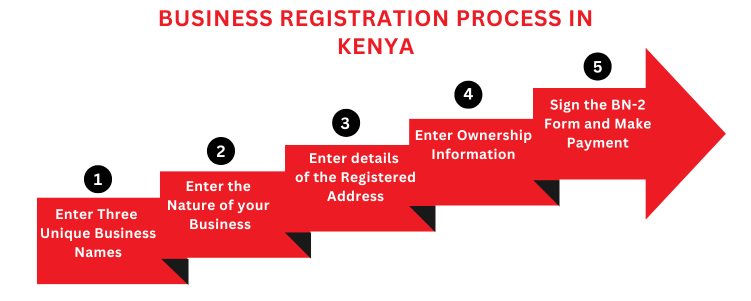
Register your business through the eCitizen portal at ecitizen.go.ke. A sole proprietorship or business name registration costs KES 950 and takes one to three business days. If you are starting with a co-founder or plan to raise investment, register a limited company through the Business Registration Service on the same portal, which costs KES 10,650 and takes five to ten business days. A registered business name is required to open a business bank account, apply for M-Pesa Paybill, and sign contracts with clients. Operating informally limits your growth more than most entrepreneurs realise.
Open a business bank account and set up M-Pesa for business
Once registered, open a business bank account with any Kenyan commercial bank. Equity Bank, KCB, Co-op Bank, and NCBA all have accounts designed for small businesses with low or no monthly fees. Next, apply for an M-Pesa Paybill or Till number through the Safaricom Business portal. A Paybill number is essential for any online business in Kenya as the majority of your customers will want to pay via M-Pesa. For your website, integrate M-Pesa payments through the Safaricom Daraja API or a payment gateway like Pesapal, Flutterwave, or DPO Pay that handles the technical integration for you.
Choose and register a domain name
Your domain name is your address on the internet. Choose something short, memorable, and relevant to your business. A .co.ke domain signals to Kenyan customers and Google that you are a locally based business and typically costs KES 1,500–2,000 per year from registrars like Truehost, Hostpinnacle, or Sasahost. A .com is also fine and costs roughly the same. Avoid hyphens, numbers, or overly long names. Register your domain before it is taken, even before your website is ready.
Build your professional website
Your website is your most important business asset online. It works 24 hours a day, builds credibility with potential customers, and is the foundation for all your digital marketing, including Google Search, social media, and email. For most Kenyan small businesses, a WordPress website with WooCommerce for e-commerce is the most flexible and cost effective option. Ensure your website loads fast on mobile (over 70% of Kenyan internet traffic is mobile), integrates M-Pesa payments, and has clear calls to action on every page. A professionally built website for a Kenyan business typically costs KES 25,000–80,000 depending on complexity. See our web design services page for our current packages.
Set up your Google Business Profile
Even if your business operates entirely online, a Google Business Profile puts you on Google Maps and in local search results, giving you visibility in front of customers searching for your services in your area. It is completely free to set up and is one of the highest return activities any Kenyan business can do in 2026. See our complete guide on how to set up your Google Business Profile in Kenya for a full walkthrough.
Create business social media profiles
Choose the platforms your target customers use most and commit to them consistently. For B2C Kenyan businesses, Instagram and TikTok are increasingly dominant for discovery, particularly in fashion, beauty, food, and lifestyle. Facebook remains essential for reaching older demographics and running targeted ads on a Kenyan budget. LinkedIn is the priority for B2B and professional services. Create your profiles with a consistent logo, business name, and contact information, and link every profile back to your website.
Attract your first customers
Getting your first paying customers is the hardest part of any new online business. Start with your existing network: tell everyone you know what you are doing and ask for referrals. Offer a discounted or free trial to your first few customers in exchange for honest testimonials and reviews. Publish content that answers the questions your customers are searching for on Google. Run a small, tightly targeted Facebook or Instagram ad campaign with as little as KES 500 per day to test your offer with a local Kenyan audience before scaling your spend.
Real Result: How a Nairobi-Based Nutritionist Built a KES 180,000/Month Online Consulting Business in Six Months
Client: Nutrition and wellness consultant, Nairobi
This client came to us in mid-2025 as a qualified nutritionist working in a hospital who wanted to build an online consulting practice as a side business with the goal of eventually going full-time. She had expertise and credentials but no website, no social media presence, and no system for attracting or onboarding online clients.
We built her a professional WordPress website with a clear service menu, an M-Pesa and card payment booking system, and a blog section to publish nutrition content for Kenyan audiences. We set up her Google Business Profile, optimised her LinkedIn profile, and helped her establish an Instagram account focused on practical Kenyan nutrition content rather than generic diet advice.
Within three months her website was ranking on the first page of Google for “nutritionist Nairobi” and related keywords. Her Instagram grew to 4,200 followers, driven almost entirely by short-form recipe and meal planning content tailored to Kenyan foods and budgets. She began taking online consultations at KES 3,500 per session via Google Meet, with M-Pesa payment made in advance through her website.
By month six she had left her hospital role and was running her nutrition consulting business full-time, earning more than twice her previous salary with full control over her schedule. Her primary client acquisition channels were Google search (via her website and Google Business Profile), Instagram, and word-of-mouth referrals from satisfied clients. Total initial investment was approximately KES 55,000, covering website development, domain and hosting, and the first month of content support.
Results vary depending on niche, competition, and effort applied. This client combined professional credentials, consistent content output, and a technically strong digital presence, all three elements contributed to her results.
Accepting Payments Online in Kenya: Your Options
Payment is where many Kenyan online businesses lose customers. If paying you is complicated, slow, or requires a bank transfer with manual confirmation, a significant portion of potential customers will abandon the transaction. The good news is that Kenya has some of the best mobile money infrastructure in the world, and your payment system should be built around it.
M-Pesa Paybill and Till
Every Kenyan online business should have either a Paybill number (for businesses) or a Till number (for merchants). These allow customers to pay via M-Pesa using a reference number. For manual transactions such as bank transfers confirmed by M-Pesa message, a Till or Paybill is the minimum viable setup. For automated website payments, you need an API integration through a gateway.
Payment gateways for website integration
To automate M-Pesa payments on your website so that a customer clicks a button, enters their phone number, receives an STK Push prompt, and is automatically redirected to a confirmation page, you need a payment gateway. The most commonly used by Kenyan businesses are Pesapal, DPO Pay (formerly 3G Direct Pay), Flutterwave, and Paystack. Each integrates with WooCommerce, Shopify, and custom websites and supports M-Pesa, Visa, and Mastercard. Fees are typically 2.5% to 3.5% per transaction.
International payments
If you are selling to clients outside Kenya, whether diaspora, African clients in other countries, or international customers, you need to accept dollars, euros, or pounds. Stripe is available in Kenya for outbound payments. PayPal is widely used but has significant withdrawal limitations for Kenyan accounts. Wise (formerly TransferWise) is a popular and low-cost option for receiving international transfers. Flutterwave and Paystack both support multi-currency international card payments and have strong Kenya support.
Important: Whatever payment methods you accept, make them visible and obvious on your website and social media. Kenyan customers frequently abandon a purchase not because they don’t want to buy, but because they couldn’t easily figure out how to pay. Display your Paybill number, accepted cards, and M-Pesa STK Push availability prominently on your checkout page, pricing page, and contact page.
How to Market Your Online Business in Kenya
Building a website and setting up payments is the foundation. Marketing is what brings customers through the door. The most effective marketing channels for Kenyan online businesses in 2026 depend on your business model, your budget, and where your specific customers spend their time online.
Search Engine Optimisation (SEO)
SEO is the process of making your website appear near the top of Google when potential customers search for what you offer. It is the highest-return long-term marketing investment for most Kenyan businesses because it delivers consistent, free traffic once your pages rank. Focus on creating genuinely helpful content that answers the questions your Kenyan customers are searching for. See our full guide on On-Page SEO in Kenya for a detailed breakdown of how to approach this.
Google Business Profile and local search
As covered in our sister guide, a fully optimised Google Business Profile puts you in front of local customers who are actively searching for your services right now. For businesses serving a Kenyan audience, local search is often the fastest source of high-intent leads.
Social media content marketing
Organic social media, posting consistently on Instagram, TikTok, Facebook, or LinkedIn without paying for ads, remains one of the most accessible marketing channels for Kenyan businesses with limited budgets. The key is to create content that is genuinely useful, entertaining, or relevant to your specific audience rather than generic promotional posts. Show your product being used, share behind-the-scenes content, answer common customer questions, and feature testimonials from satisfied Kenyan customers.
WhatsApp marketing
WhatsApp is Kenya’s most used communication platform and an underrated marketing channel. A WhatsApp Business account allows you to set up an automated greeting message, a business profile with your hours and catalogue, and broadcast messages to opted-in customers. Building a WhatsApp broadcast list of existing customers and warm leads and sending them relevant offers, new products, or useful content is one of the most cost-effective marketing tactics available to Kenyan businesses.
Paid advertising
Facebook and Instagram ads allow you to reach specific Kenyan audiences by location, age, interests, and behaviour for as little as KES 500 per day. Google Ads places your business at the top of search results for targeted keywords and charges you only when someone clicks. Both are effective for Kenyan businesses but require careful campaign setup and ongoing optimisation to avoid wasting budget. Start small, test your ad creative and targeting, and scale only what demonstrably produces leads or sales.
Common Mistakes Kenyans Make When Starting an Online Business
| Mistake | Why it hurts you | What to do instead |
|---|---|---|
| Starting without validating the idea | You invest time and money building something nobody wants to buy | Talk to ten real potential customers before building anything; confirm willingness to pay first |
| Operating without legal registration | Cannot open a business bank account, apply for Paybill, or sign client contracts | Register on eCitizen for KES 950 before doing anything else; it takes less than a week |
| Using a free website builder instead of a professional site | Limits your SEO, credibility, and ability to integrate M-Pesa and custom features | Invest in a professional WordPress website from the start; the ROI justifies the cost quickly |
| Making payment difficult or unclear | Customers abandon the purchase when they can’t easily figure out how to pay | Display your Paybill, STK Push, and card options prominently; integrate automated payment on your website |
| Trying to be on every social platform at once | You spread yourself thin, produce mediocre content everywhere, and build no meaningful audience anywhere | Pick one or two platforms where your target customers are most active and commit fully |
| No Google presence (website + GBP) | Customers searching on Google, the most common way Kenyans discover businesses, cannot find you | Build a website and set up your Google Business Profile before spending on paid ads |
| Giving up too early | Most online businesses take 3–6 months to generate consistent revenue; quitting at month two is giving up just before traction begins | Set a realistic 6-month timeline, track meaningful metrics (not just followers), and commit to consistent execution |
| Selling on price alone | There will always be someone cheaper, and competing on price alone is a race to the bottom that destroys margins | Compete on quality, speed, trust, or specialisation; communicate your value clearly on your website and social media |
Legal and Tax Considerations for Online Businesses in Kenya
Running an online business in Kenya does not exempt you from the legal and tax obligations that apply to any Kenyan business. Getting this right from the start protects you from penalties, enables you to work with corporate clients who require compliant suppliers, and builds credibility with customers.
Business registration
As covered above, register your business through the eCitizen portal. A sole proprietorship (business name) is sufficient for most individuals starting out. A limited liability company is advisable if you are starting with partners, plan to hire employees, or intend to work with corporate or government clients who require a registered company.
KRA PIN and tax obligations
Register for a KRA PIN at iTax (itax.kra.go.ke) if you do not already have one. Your business, if registered as a company, will need its own separate KRA PIN. File your income tax return annually by 30 June. If your annual turnover exceeds KES 5 million, you are required to register for VAT. Kenya’s Turnover Tax (TOT) of 1.5% applies to businesses with annual turnover between KES 1 million and KES 25 million and is filed and paid monthly. Keeping clean financial records from day one makes tax filing significantly easier.
Data protection
If your website collects personal data from customers, including names, email addresses, phone numbers, or payment details, you are required to comply with Kenya’s Data Protection Act 2019. This means publishing a clear privacy policy on your website, collecting only the data you need, and protecting that data appropriately. Businesses handling large volumes of personal data may need to register as a data controller with the Office of the Data Protection Commissioner.
How J&M Digital Solutions Helps Kenyan Entrepreneurs Start and Grow Online
At J&M Digital Solutions, we work with Kenyan entrepreneurs and established businesses at every stage of building an online presence. From the first website to ongoing SEO and Google Business Profile management, we provide the technical foundation that lets you focus on running and growing your business.
What we help with
- Professional WordPress website design and development for Kenyan businesses, including M-Pesa and WooCommerce integration
- E-commerce website setup with M-Pesa STK Push, Pesapal, and card payment integration
- Google Business Profile setup, verification, and optimisation for local search visibility
- On-page SEO to help your website rank on Google Kenya for your target keywords
- Domain registration and Kenyan business-grade web hosting setup
- Social media profile creation and content strategy for Kenyan audiences
- Ongoing website maintenance, security updates, and performance optimisation
Whether you are starting from zero or looking to significantly improve an existing online presence, we offer transparent pricing, honest timelines, and work that is built to perform in the Kenyan market.
Ready to Start or Grow Your Online Business in Kenya?
J&M Digital Solutions helps Kenyan entrepreneurs and businesses build the websites, Google presence, and digital marketing foundations they need to attract customers and generate consistent revenue online. Get in touch for a free consultation and honest advice on what your specific business needs most right now.
Phone / WhatsApp: +254 769 604 780
Website: jmdigitalsolutionske.com
Service area: Serving businesses across Kenya
Frequently Asked Questions
How much money do I need to start an online business in Kenya?
The minimum viable investment depends on your business model. A freelance or consulting business can be started for as little as KES 5,000 to 15,000 covering business registration, a domain, and basic web hosting. An e-commerce business selling physical products will typically require KES 50,000 to 150,000 or more to cover stock, a professional website, and initial marketing. The biggest mistake is under-investing in your website and online presence, as these are the primary factors that determine whether customers trust and buy from you online.
Do I need to register a business to sell online in Kenya?
Legally, any business activity in Kenya should be registered. Practically, operating without registration limits you significantly: you cannot open a business bank account, apply for an M-Pesa Paybill number, sign supplier contracts, or work with corporate clients who require KRA compliance. Registration through eCitizen costs KES 950 for a business name and takes one to three business days. There is no good reason to delay registering.
How do I accept M-Pesa payments on my website in Kenya?
To accept M-Pesa payments automatically on your website, you need an M-Pesa Paybill number and a payment gateway that integrates with the Safaricom Daraja API. The most commonly used gateways for Kenyan WordPress and WooCommerce websites are Pesapal, DPO Pay, and Flutterwave. These handle the technical integration and allow customers to pay via M-Pesa STK Push, Visa, or Mastercard directly on your site without leaving to make a manual transfer.
Which online business is most profitable in Kenya in 2026?
Profitability depends heavily on your skills, niche, and execution rather than on a single universally best model. That said, digital services and online consulting consistently offer the highest margins for individuals with expertise, because there is no inventory cost and overhead is minimal. E-commerce in categories like fashion, beauty, and electronics accessories has strong demand but thinner margins and requires better logistics management. The most profitable business for you is the one that aligns your skills with genuine Kenyan market demand and that you can execute with consistency over at least six months.
Do I need a website or can I just sell on Instagram and WhatsApp?
Many Kenyans start selling on Instagram and WhatsApp and generate their first revenue this way, which is a legitimate starting point. However, social media platforms are rented land: your account can be restricted, hacked, or algorithmically deprioritised at any time, and you have no control over it. A professional website is the only online presence you own and control. It also significantly improves your credibility with serious buyers, enables automated payment processing, and provides the foundation for Google search visibility that social media alone cannot deliver. Start on Instagram if you need to, but build a website as soon as possible.
How long does it take to make money from an online business in Kenya?
With the right model and consistent effort, most Kenyans can generate their first paying customers within two to six weeks of launching. Building a consistent monthly revenue stream, the kind that could replace a salary, typically takes three to six months of sustained effort in marketing, content, and customer service. Businesses that invest in professional websites and Google visibility from the start tend to reach consistent revenue faster than those relying solely on social media. Set realistic expectations: an online business is a real business, not a get-rich-quick scheme, and the Kenyan entrepreneurs who succeed are those who treat it accordingly.