
Your website is the first thing a potential customer judges before they ever speak to you. In Kenya’s increasingly competitive digital market, a website that looked modern two years ago can now actively cost you customers if it has not kept pace with what users expect. Kenyan consumers are more sophisticated than ever: they browse on mobile, they expect pages to load in under three seconds, and they will leave a site that feels outdated within moments of arriving.
The best website design trends in Kenya for 2026 are not about decorating your site with the latest visual gimmick. They are about building websites that convert visitors into customers faster, rank higher on Google, and work flawlessly for the 73 percent of Kenyan internet users who browse primarily on a smartphone. This guide covers the trends that matter most for Kenyan businesses right now, and how to apply them practically without rebuilding your entire site from scratch.
For related guides, read our posts on web design services in Kenya, WordPress website design in Kenya, and e-commerce website design in Kenya.
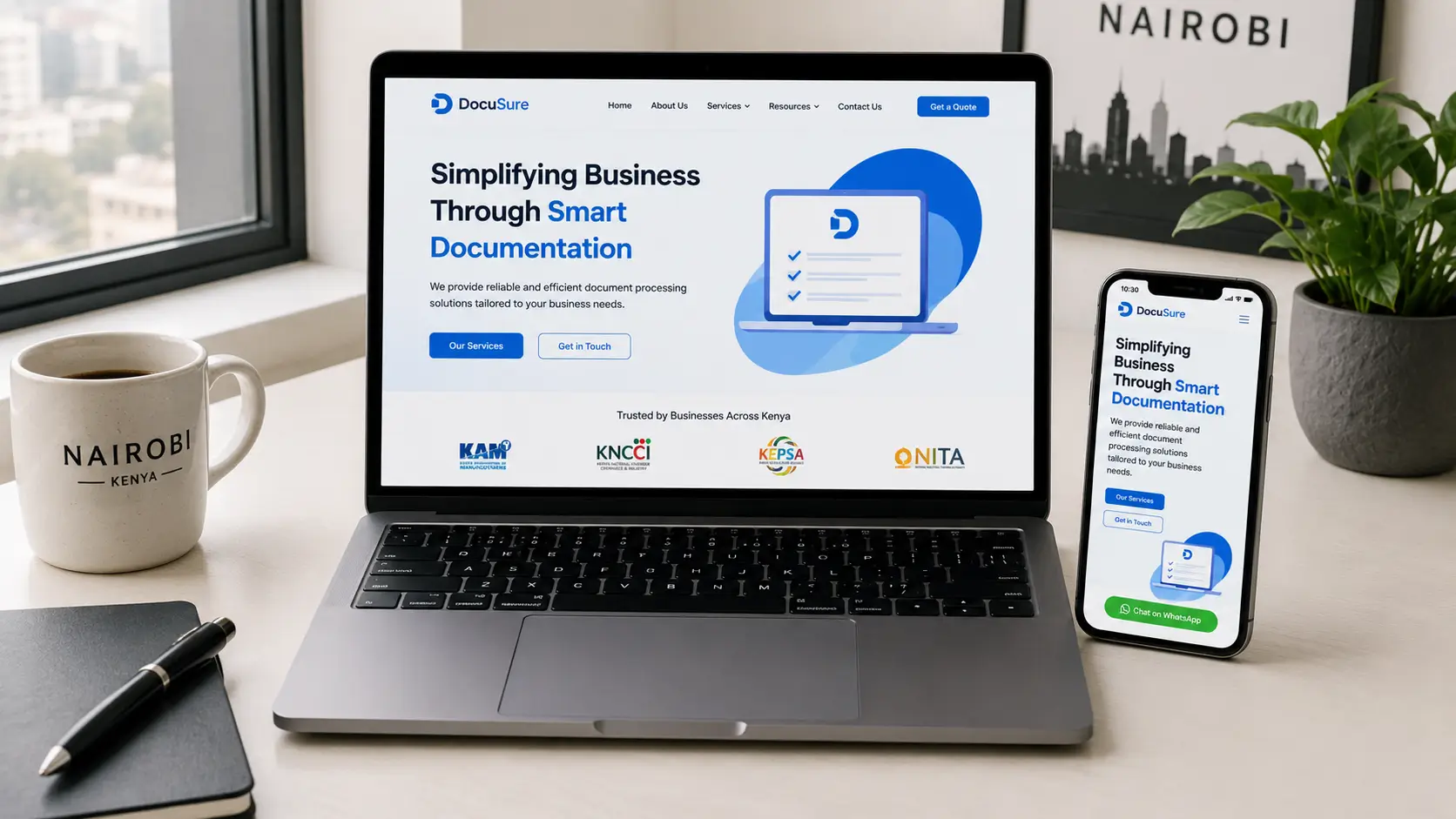
Why Website Design Trends Matter for Kenyan Businesses in 2026
Design trends are not vanity. They are a direct reflection of how user behaviour and search engine expectations have shifted. Google’s 2026 ranking algorithm places significant weight on Core Web Vitals, which measure how fast your pages load, how stable your layout is as it loads, and how quickly users can interact with your content. A website that violates these performance benchmarks will rank lower than a competitor’s site that meets them, regardless of how good your content is. Design decisions, from image formats to layout complexity to font loading, directly affect these scores.
Beyond SEO, Kenyan consumer expectations have been shaped by world-class apps and platforms. A business owner in Nairobi who uses M-Pesa, Instagram, and YouTube daily has experienced smooth, fast, and visually clean digital interfaces. When they land on a Kenyan business website that takes five seconds to load, has text too small to read on mobile, or looks identical to a 2019 WordPress template, the credibility gap is immediate and damaging. The best website design trends in Kenya for 2026 close that gap and give your business the professional presence it deserves.
Key fact: Over 73 percent of Kenyan internet users access the web primarily through smartphones, according to the DataReportal Kenya Digital 2026 report. This means every website design decision, from layout to button size to page speed, must be made with a mobile user in mind first. A desktop-first website is not just outdated in Kenya: it is actively driving away the majority of your potential customers before they ever read a word about your business.
The Best Website Design Trends in Kenya for 2026
Mobile-first design as a non-negotiable baseline
Mobile-first design means building your website for the smallest screen first and scaling up to desktop, rather than the reverse. In 2026, this is no longer a trend but an absolute baseline requirement for any Kenyan business website. With over 73 percent of local internet traffic coming from smartphones, a site that is not genuinely optimised for mobile is losing the majority of its potential visitors before they even see what you offer. Mobile-first means large tap targets, text that is readable without zooming, single-column layouts for key content on small screens, and images that do not take 10 seconds to load on a Safaricom data connection. Every website J&M Digital Solutions builds starts with the mobile experience and builds outward from there.
Performance-first design and Core Web Vitals optimisation
Page speed is now a direct Google ranking factor, and Kenyan businesses that ignore it are surrendering search visibility to faster competitors. The best website design trends in Kenya for 2026 prioritise performance at every level: images converted to WebP format, lazy loading for below-the-fold content, minimal JavaScript that blocks rendering, and hosting on servers with data centres close to East Africa to reduce latency. A well-built WordPress website on quality Kenyan hosting should achieve a Google PageSpeed score of 85 or above on mobile. If your current site scores below 50, it is likely costing you both search rankings and conversions every single day.
Clean, conversion-focused minimalism
Pure minimalism in 2026 has evolved beyond bare white pages. The strongest Kenyan business websites combine clean layouts with deliberate moments of visual impact: a bold hero section, a clear value proposition, and a single obvious call to action on every page. Cluttered websites with too many colours, too many fonts, and too many competing messages still dominate the Kenyan SME space and they are costing those businesses enquiries daily. A visitor who cannot immediately understand what you do and how to contact you will leave within seconds. Minimalism is not about making your site look simple. It is about making the path to conversion as short and obvious as possible for every visitor.
WhatsApp and M-Pesa integration as design elements
This is one of the most Kenya-specific website design trends for 2026, and one that international design resources will not tell you about. For Kenyan business websites, the WhatsApp chat button and M-Pesa payment option are not optional integrations added as an afterthought. They are conversion-critical design elements that belong prominently on every page. A floating WhatsApp button in the bottom corner of your site gives every visitor a one-tap path to starting a conversation with you regardless of which page they are on. An M-Pesa payment option at checkout removes the biggest barrier to online purchases for Kenyan consumers. Websites that treat these as decoration rather than design priorities consistently underperform on enquiries and sales compared to those that make them central to the user journey.
Bold typography and clear visual hierarchy
In 2026, bold and confident typography is one of the dominant global design trends, and it translates exceptionally well to Kenyan business websites. Large, clear headings that communicate your core value proposition without the visitor having to read a paragraph establish trust in the first three seconds. Typography-led design also loads faster than image-heavy design, which is a significant advantage on mobile data connections. For Kenyan businesses, the practical application is to ensure your homepage hero section communicates what you do, who you serve, and where you are located in a single bold headline, supported by a subheadline and one clear call-to-action button. Everything else on the page is secondary to that core message.
Local photography and authentic brand imagery
One of the most visible and most neglected website design trends in Kenya is the use of genuine local photography instead of generic Western stock images. A financial services website showing a Nairobi CBD office, real team members, and Kenyan client environments builds significantly more trust with local audiences than a site using photographs of people who clearly are not Kenyan. In 2026, stock photo fatigue is real: users have become adept at identifying generic imagery and it subconsciously signals to them that the business behind the website is not invested in their local market. Even a basic professional photo shoot of your team, workspace, and products will outperform expensive stock imagery for conversion on a Kenyan business website.
AI-assisted chat and smart lead capture
AI-powered chatbots and smart lead capture forms are rapidly becoming a baseline feature of well-designed Kenyan business websites in 2026. Rather than a static contact form that sends an email no one reads until the following morning, an AI chat widget can greet visitors, answer frequently asked questions about pricing and services, and route serious enquiries directly to your WhatsApp in real time. For Kenyan businesses in sectors like real estate, insurance, legal services, and financial advice, where the path from visitor to customer involves multiple questions before a commitment, AI-assisted chat can double the number of qualified leads a website generates without adding to your workload. Plugins like Tidio, Crisp, and HubSpot’s free chat tool integrate directly with WordPress and WhatsApp.
Google Business Profile integration and local SEO signals
One of the most underutilised website design trends in Kenya for 2026 is the deliberate integration of local SEO signals directly into the website’s design and content structure. This means embedding your Google Maps location on your contact page, displaying your Google Business Profile review rating prominently on your homepage, including your Nairobi or Kenya location in page titles and meta descriptions, and using structured data markup that tells Google exactly what type of business you are and where you serve. These design decisions directly improve how your site performs in Google’s local search results and Google Maps, which are increasingly the primary way Kenyan consumers discover and evaluate local businesses. See our guide on Google Business Profile in Kenya for how to connect your website and GBP for maximum local search visibility.
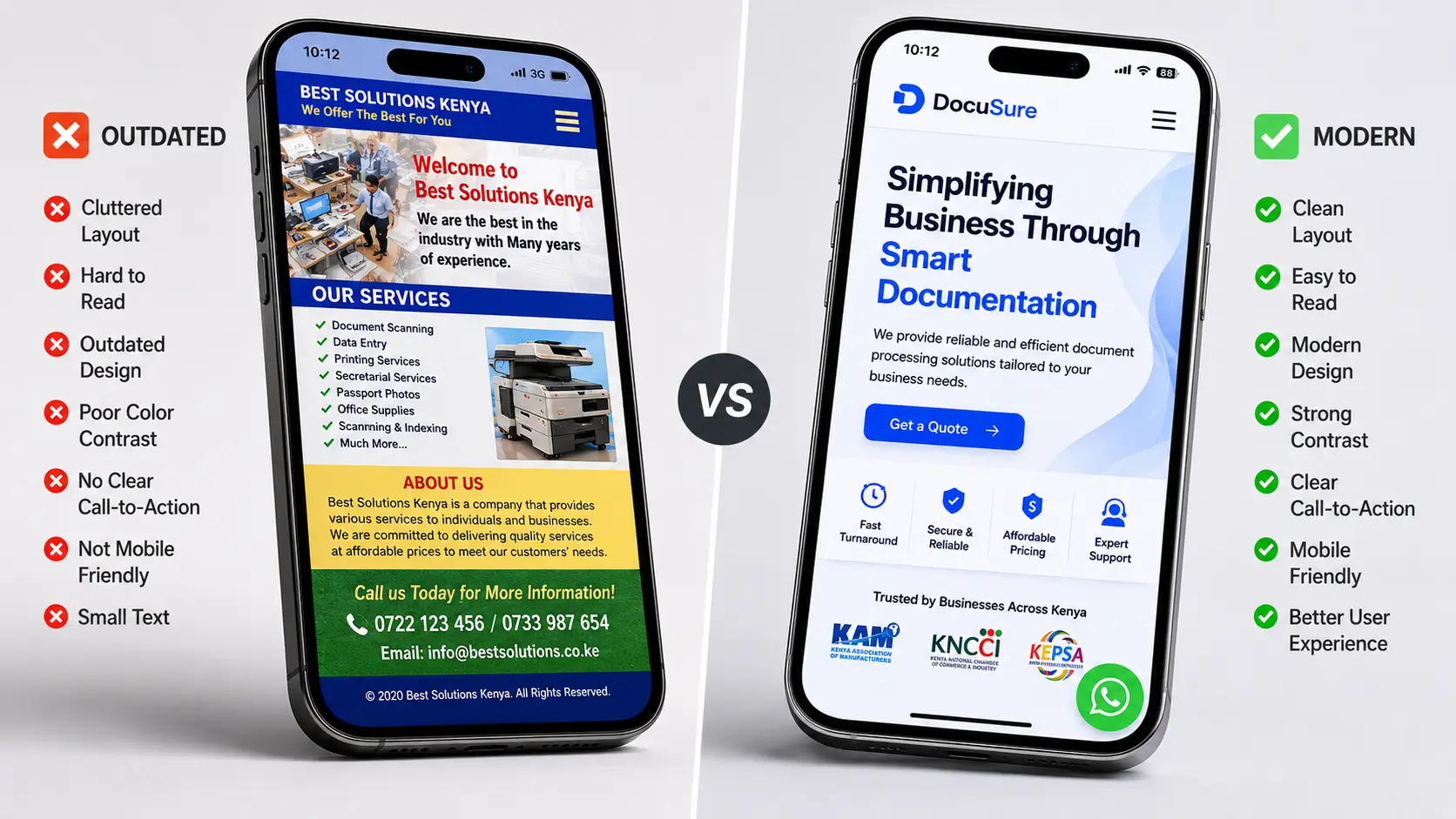
Website Design Trends: What Works vs What to Avoid for Kenyan Businesses
| Design Choice | Status in 2026 | Kenya-specific reason |
|---|---|---|
| Mobile-first responsive design | Essential | 73%+ of Kenyan internet users browse on smartphones; a non-mobile site loses most of its traffic immediately |
| WhatsApp chat button on every page | Essential | WhatsApp is Kenya’s dominant business communication channel; every page should offer a one-tap path to conversation |
| WebP images and lazy loading | Essential | Reduces load times on mobile data connections; directly improves Google PageSpeed scores and search rankings |
| Local Kenyan photography | Strongly recommended | Builds trust with Kenyan audiences who can immediately identify generic Western stock images |
| Bold homepage headline with clear CTA | Strongly recommended | Reduces bounce rate by immediately communicating what the business does and what the visitor should do next |
| M-Pesa payment integration | Essential for e-commerce | Kenyan online shoppers expect M-Pesa at checkout; sites without it have significantly higher cart abandonment |
| Autoplay video backgrounds | Avoid | Heavy on data, slow to load on mobile connections, and penalised by Google’s Core Web Vitals scoring |
| Excessive pop-ups | Avoid | Penalised by Google on mobile, annoys users, and increases bounce rate; one well-timed exit-intent pop-up is the maximum |
| Prices in USD on Kenyan sites | Avoid | Reduces purchase intent significantly; always display pricing in KES for local audiences |
| Dark mode design | Optional but growing | Increasingly expected on tech and creative sites; at minimum, respect the user’s OS dark mode preference via CSS |
Real Result: How a Nairobi Professional Services Firm Doubled Enquiries After a Website Redesign
Client: HR and recruitment consultancy, Upper Hill, Nairobi
This client had a website built in 2021 that had not been updated since launch. It scored 38 out of 100 on Google PageSpeed for mobile, had no WhatsApp integration, used generic stock photos of non-African professionals, and displayed a contact form as the only enquiry option. The homepage headline read “Welcome to our website” with no immediate indication of what the business did or who it served.
We redesigned the site on WordPress following the best website design trends in Kenya for 2026: a bold homepage headline stating their exact service and target market, local photography from a half-day shoot, WebP image compression, a floating WhatsApp button on every page, a Google Maps embed on the contact page, and structured data markup for local SEO. PageSpeed mobile score improved from 38 to 87. Within 60 days of relaunch, monthly website enquiries had doubled, with 68 percent of new enquiries coming through the WhatsApp button rather than the contact form.
Results vary depending on your industry, existing traffic levels, and how actively you promote your website through SEO and social media. This client already had consistent traffic; the redesign converted more of that existing traffic into enquiries.
Is Your Current Website Following the Best Design Trends for Kenya in 2026?
Use this quick checklist to assess where your current website stands against the best website design trends in Kenya for 2026. If you answer no to more than three of these questions, a professional redesign is likely to generate a measurable return on investment within 90 days.
- Does your website load in under three seconds on a mobile data connection?
- Does your homepage immediately communicate what your business does and who it serves in a single headline?
- Is there a visible WhatsApp button on every page of your site?
- Are all images on your site compressed and in WebP format?
- Does your site score above 70 on Google PageSpeed Insights for mobile?
- Does your website look clean and readable on a 5-inch smartphone screen without zooming?
- Do you use real local photography rather than generic stock images?
- Is your Google Business Profile linked and your location embedded on your contact page?
- Does your site have a clear call-to-action button above the fold on the homepage?
- If you sell products or services online, does checkout support M-Pesa payments?
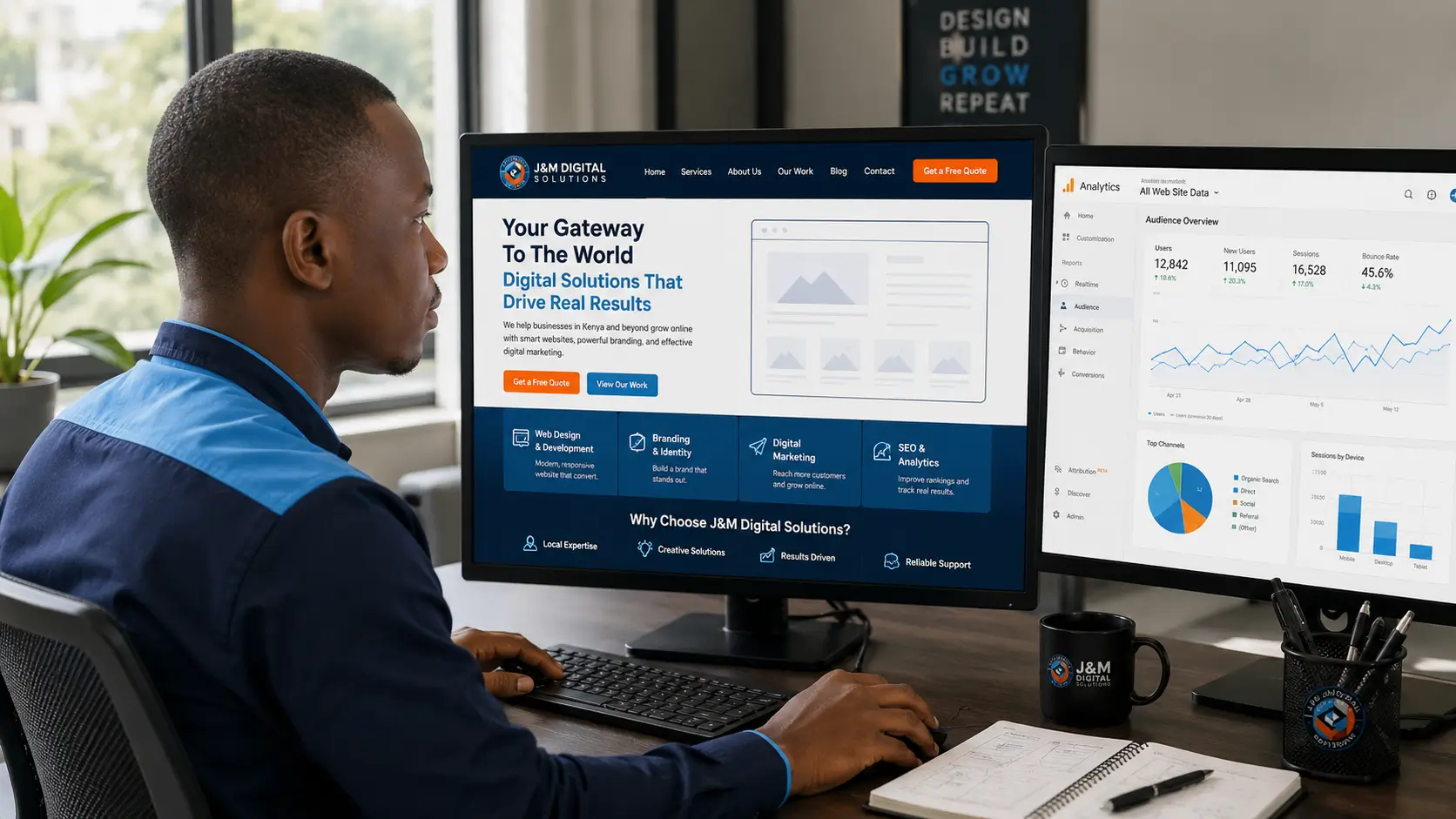
How J&M Digital Solutions Applies 2026 Website Design Trends for Kenyan Businesses
At J&M Digital Solutions, every website we build for Kenyan businesses is designed around the principles that actually move the needle in 2026: mobile-first layout, fast load speeds, clear conversion paths, WhatsApp integration, and local SEO signals built into the design from day one. We do not build websites to win design awards. We build websites that rank on Google Kenya, convert visitors into enquiries, and give Kenyan businesses a digital presence that builds trust with local customers the moment they land on the page.
- Custom WordPress website design in Kenya built mobile-first with fast load speeds and conversion-focused layouts
- Full e-commerce website design in Kenya with M-Pesa STK push, product SEO, and WhatsApp integration
- WhatsApp chat button integration, Google Maps embedding, and local structured data markup
- WebP image optimisation, lazy loading, and Core Web Vitals performance improvements
- SEO services in Kenya built into every page from the start, not added as an afterthought
- Website audits and redesigns for existing Kenyan business sites not performing on mobile or Google
Does Your Website Reflect the Best Design Trends for Kenya in 2026?
J&M Digital Solutions builds and redesigns websites for Kenyan businesses that want to rank higher on Google, convert more visitors into customers, and look as professional online as they are in person. If your current site is slow, not mobile-friendly, or generating fewer enquiries than it should, we can fix that.
Phone / WhatsApp: +254 769 604 780
Website: jmdigitalsolutionske.com
Service area: Serving businesses across Kenya
Frequently Asked Questions
What is the most important website design trend in Kenya for 2026?
Mobile-first design is the single most important trend, and it has been for several years. With over 73 percent of Kenyan internet users browsing on smartphones, a website that is not genuinely optimised for mobile screens is immediately losing the majority of its potential visitors. After mobile-first, page speed is the second most critical factor, as it directly affects both user experience and Google search rankings through Core Web Vitals scoring. A site that loads in under three seconds on a mobile data connection and communicates clearly on a small screen will consistently outperform a visually impressive but slow desktop-first design.
How much does a modern website redesign cost in Kenya in 2026?
A professional WordPress website redesign for a Kenyan business typically costs between KES 40,000 and KES 80,000 depending on the number of pages, complexity of features, and whether e-commerce or M-Pesa integration is required. A basic informational website with five to eight pages, WhatsApp integration, and local SEO setup sits at the lower end of that range. An e-commerce store with M-Pesa STK push, product catalogue, and delivery calculator sits at the higher end. The return on investment is typically visible within 60 to 90 days through improved Google rankings, lower bounce rates, and higher enquiry volumes.
Should Kenyan businesses use dark mode on their websites in 2026?
Dark mode is growing in popularity globally and is increasingly expected on technology, creative, and premium brand websites. However, for most Kenyan small and medium businesses in sectors like retail, professional services, food, and hospitality, a clean light design with strong contrast and fast load speeds will outperform a dark mode design in terms of conversions and readability across different devices and lighting conditions. The minimum recommended approach is to ensure your WordPress website respects the user’s operating system dark mode preference through CSS, without necessarily designing a full dark-first interface. Full dark mode implementation is best done as part of a comprehensive redesign by a professional team.
How do I check if my Kenyan business website follows 2026 design best practices?
The quickest way to assess your current website is to run it through Google PageSpeed Insights at pagespeed.web.dev using your website URL. This free tool gives you a mobile and desktop performance score, identifies specific issues slowing your site down, and flags Core Web Vitals problems that may be affecting your Google rankings. For a broader assessment, open your website on a smartphone and ask yourself honestly whether it is easy to read, fast to load, and obvious what a visitor should do next. If you find it difficult to navigate on mobile, your customers are experiencing the same thing. J&M Digital Solutions offers free website audits for Kenyan businesses, contact us on WhatsApp to request one.
Does website design affect SEO rankings in Kenya?
Yes, significantly. Google’s ranking algorithm in 2026 places direct weight on Core Web Vitals, which measure page speed, layout stability, and interactivity, all of which are determined by design and development decisions. A slow, mobile-unfriendly, or visually unstable website will rank below a well-designed competitor site even if your content is stronger. Beyond Core Web Vitals, design choices such as clear heading structure, local SEO signals like embedded Google Maps and location-specific page titles, and structured data markup all contribute to how well your site ranks for Kenyan search queries. Good website design and good SEO are not separate activities in 2026; they are the same activity approached from two directions.