
If you want to rank your online store on Google, e-commerce SEO in Kenya is not the same problem as ranking a normal business website. A service page only needs to rank once. An online store needs every product page and every category page to independently earn visibility, often against manufacturer listings, marketplaces, and dozens of competitors selling the exact same item. This guide covers what actually moves the needle: product page SEO, category page structure, product schema markup, and the WooCommerce-specific technical issues that quietly hold Kenyan stores back.

Why Regular SEO Advice Falls Short for E-commerce SEO in Kenya
Most general SEO guidance is written with a handful of pages in mind: a homepage, a few service pages, a contact page. An online store can have hundreds of product pages, each one thin by design (a product name, a price, a short description) and each one competing against the exact same product listed on other stores. If you are already comparing quotes for a new build, our e-commerce website design in Kenya packages include basic SEO setup, but ranking a store long-term takes ongoing, product-level work beyond what any one-off build covers.
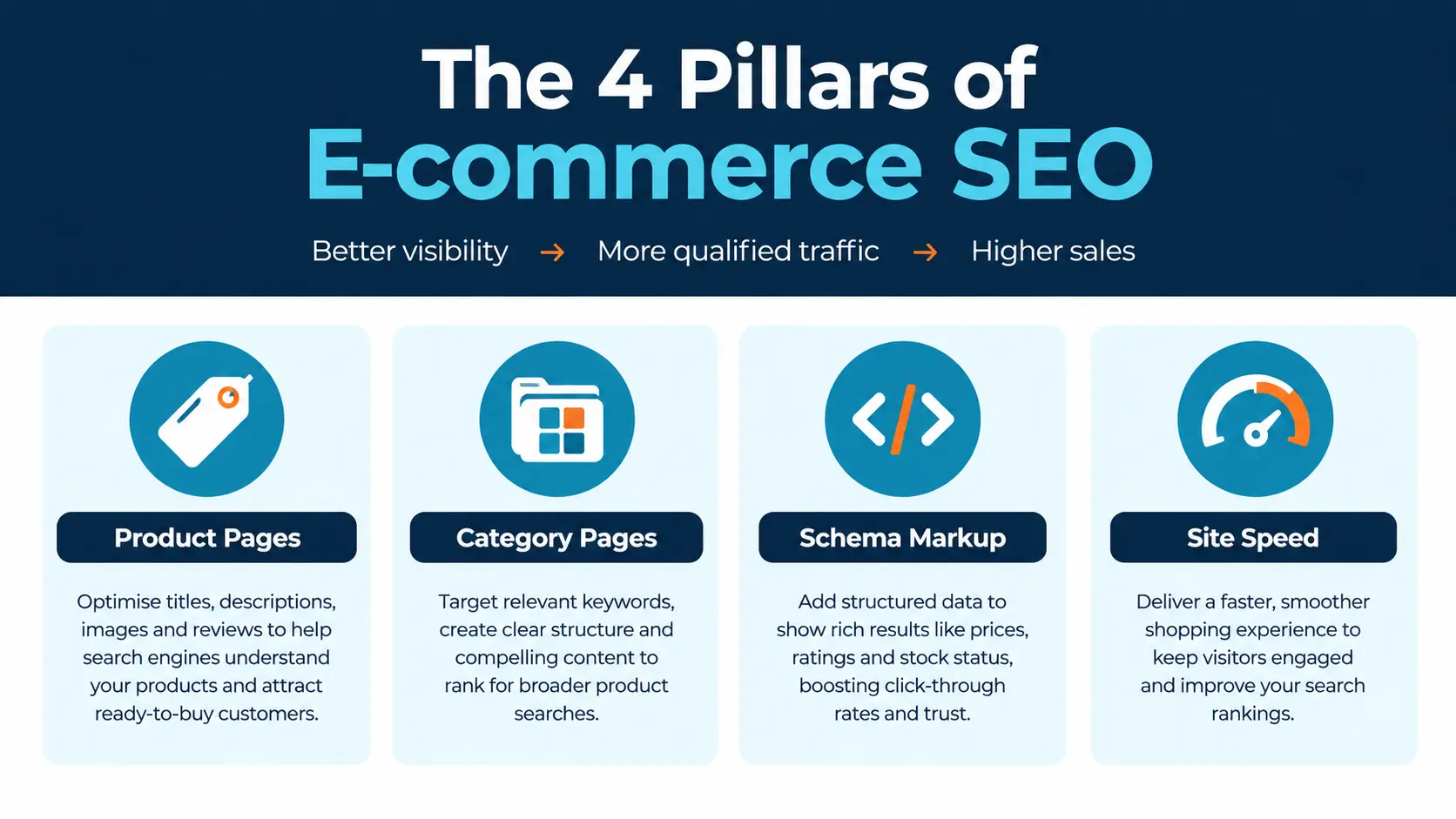
Product Page SEO: Getting Individual Products to Rank
Product page SEO is where most e-commerce SEO in Kenya efforts should start, since these are the pages closest to an actual sale, and getting them right is the fastest way to rank your online store on Google for buyer-intent searches.
Write Unique Product Descriptions
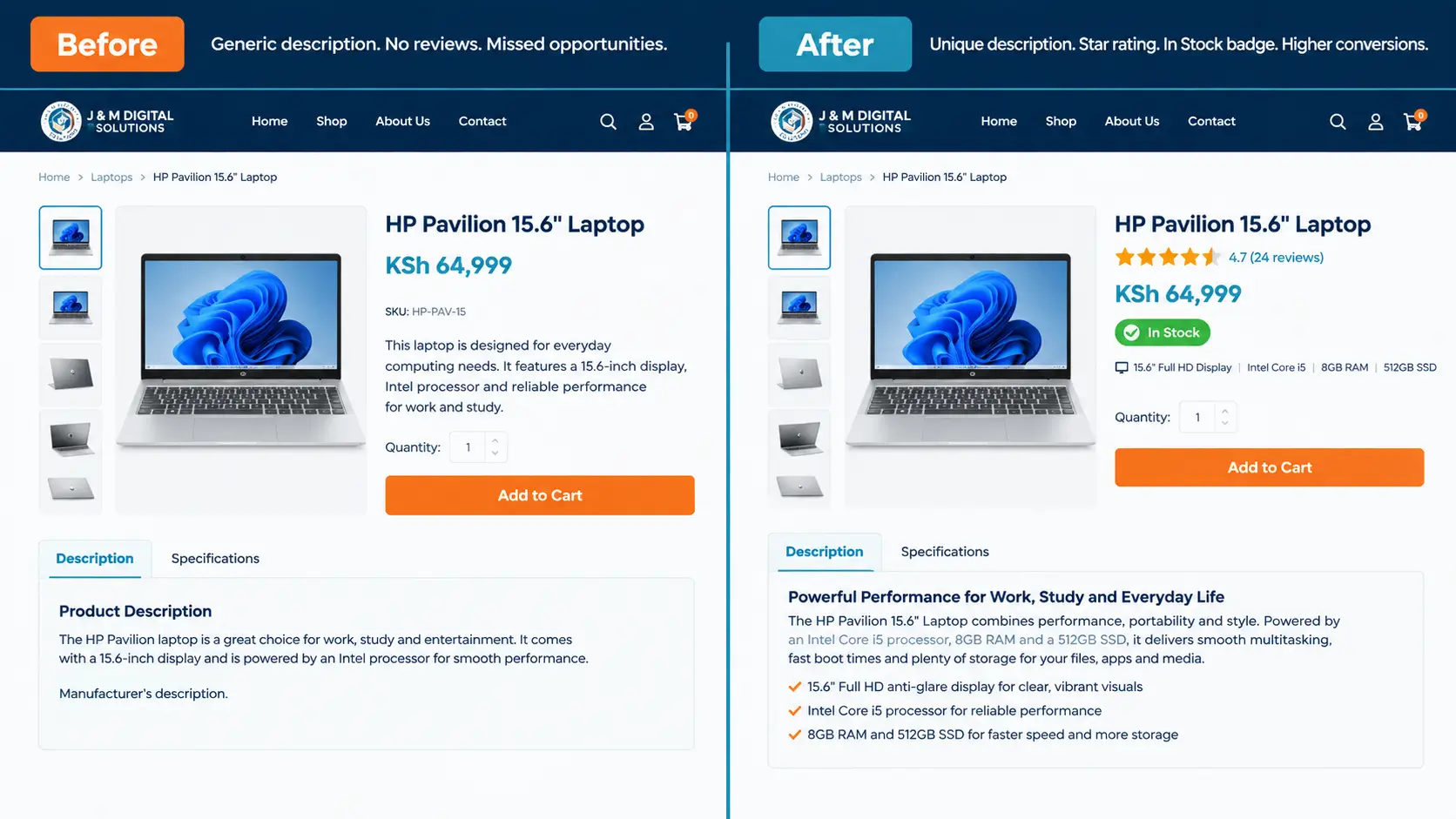
Copying the manufacturer’s description word for word is the single most common product page SEO mistake. If ten other Kenyan stores sell the same product and all ten paste the same manufacturer text, Google has no reason to rank any one of them above the others. A rewritten description, even a short one covering the same facts in your own words, gives your product page a genuine chance to stand out.
Optimise Titles and Meta Descriptions Per Product
Each product needs its own title and meta description, not a template that repeats your store name and category with only the product name swapped in. Include the product name, a key specification buyers search for (size, colour, model), and, where relevant, “in Kenya” or your delivery area.
Use Descriptive Image Alt Text
Product photos should have alt text describing the actual product, not a generic file name like IMG_2841.jpg. This helps the image itself rank in Google Image search, which sends real traffic for visually driven categories like fashion, furniture, and home decor.
Category Page SEO: A Core Part of E-Commerce SEO in Kenya
Category page SEO is frequently skipped entirely, treated as just a container for products rather than a page that can rank on its own. A category page targeting a broader term, like “office chairs Kenya” rather than one specific chair, often has more ranking potential than any single product inside it.
Good e-commerce SEO in Kenya practice means an empty or near-empty category page, common on newer Kenyan stores still building out their catalogue, signals thin content to Google. If a category only has two or three products, consider merging it into a broader category until you have enough inventory to justify a dedicated page.
Product Schema Markup: Getting Rich Results in Search
Product schema markup is structured data that tells Google specific facts about your product, price, availability, and review rating, so that information can appear directly in search results as a rich result, instead of Google having to guess by reading your page text.
| Schema property | What it shows in search results |
|---|---|
| price | The product’s KES price displayed directly under the search listing |
| availability | “In stock” or “Out of stock” shown before a customer even clicks through |
| aggregateRating | Star ratings displayed under the listing, if you have genuine product reviews |
Most WooCommerce SEO plugins (Rank Math, Yoast) generate basic schema markup automatically once configured correctly. The most common mistake is leaving fields like availability unset, which means Google simply omits that part of the rich result rather than displaying anything useful.
WooCommerce SEO: The Technical Side of E-Commerce SEO in Kenya
WooCommerce SEO involves several technical issues that a normal WordPress site never runs into, because they only appear once you have a real product catalogue.
Out-of-Stock and Duplicate URL Handling
When a product sells out, do not delete the page. A deleted product page becomes a dead link, wasting any ranking signal it had already earned. Mark it out of stock instead, or set up a redirect to a similar in-stock product if you do not plan to restock.
Pagination on Category Pages
Category pages with many products split across several pages need proper pagination handling, so Google understands page 2 and page 3 are part of the same category rather than separate, thin duplicate pages competing against each other.
Site Speed With a Large Catalogue
A store with hundreds of product images on basic hosting will load slowly, and slow load times hurt both ranking and conversion. Product page SEO and category page SEO work are wasted if the page itself takes six seconds to load on mobile data. If you are unsure what your current hosting costs and whether it is enough for your catalogue size, our e-commerce website cost in Kenya guide breaks down hosting tiers by store size.
Common E-Commerce SEO in Kenya Mistakes
| Mistake | Why it hurts you | What to do instead |
|---|---|---|
| Copying manufacturer product descriptions | Every store selling the same product looks identical to Google, so none of them stand out | Write unique product page SEO copy, even a short rewritten paragraph |
| Leaving category pages empty of text | Reads as thin content, since it is just a product grid with nothing else | Add a short introductory paragraph to every category page |
| Deleting sold-out product pages | Wastes any ranking signal the page had already built, and creates a dead link | Mark the product out of stock, or redirect to a similar item |
| Skipping schema markup | Competitors with it get rich results (price, stock, ratings) showing directly in search, yours does not | Configure it through your SEO plugin, and check every field is filled in |
| Using generic image file names and alt text | Misses genuine traffic from Google Image search on visual categories | Write descriptive alt text naming the actual product |
How E-Commerce SEO in Kenya Fits With Your Wider SEO Work
E-commerce SEO in Kenya does not replace the fundamentals, it builds on them. If you have not yet done proper keyword research to identify what your specific online store keywords Kenya buyers actually search for, start there before optimising individual product pages. Our on-page SEO guide covers the broader fundamentals this post builds on, and our Google Business Profile guide is worth pairing with this if your store also has a physical pickup location.
Want to Rank Your Online Store on Google?
Send us your store on WhatsApp for a real look at your e-commerce SEO in Kenya, and we will give you an honest read on your product pages, category structure, and schema setup, no vague promises, just what your store actually needs.
Chat on WhatsAppFrequently Asked Questions
How is e-commerce SEO in Kenya different from regular SEO?
Regular SEO usually optimises a small number of pages. E-commerce SEO in Kenya has to work across potentially hundreds of product and category pages at once, each one thin by nature and competing against near-identical listings from other stores.
Should I write my own product descriptions or use the manufacturer’s?
Write your own. Copying manufacturer descriptions word for word means your product page looks identical to every other store selling the same item, giving Google no reason to rank you above competitors.
What is product schema markup and do I need it?
It is structured data that tells Google your product’s price, stock status, and rating, so this information can appear directly in search results. Most WooCommerce SEO plugins can generate it automatically once properly configured, and it is worth setting up for any serious online store.
Should I delete a product page once it is out of stock?
No. Mark it as out of stock instead, or redirect it to a similar in-stock product. Deleting the page wastes any ranking signal it has already earned and creates a dead link.
Does my hosting affect my e-commerce SEO?
Yes. Slow-loading product pages hurt both ranking and conversion, particularly on mobile data connections common in Kenya. A large catalogue on basic hosting will underperform regardless of how well the pages themselves are optimised.