
If you have searched for e-commerce website cost in Kenya, you have probably found three different answers on three different websites, sometimes even on the same website. That is because most guides quote a single build price and stop there, without breaking down what you actually pay for before and after launch. This guide itemises every real cost: domain, hosting, payment gateway fees, and ongoing maintenance, so you can budget accurately instead of guessing.
Why a Single Price Tag Does Not Tell the Full Story
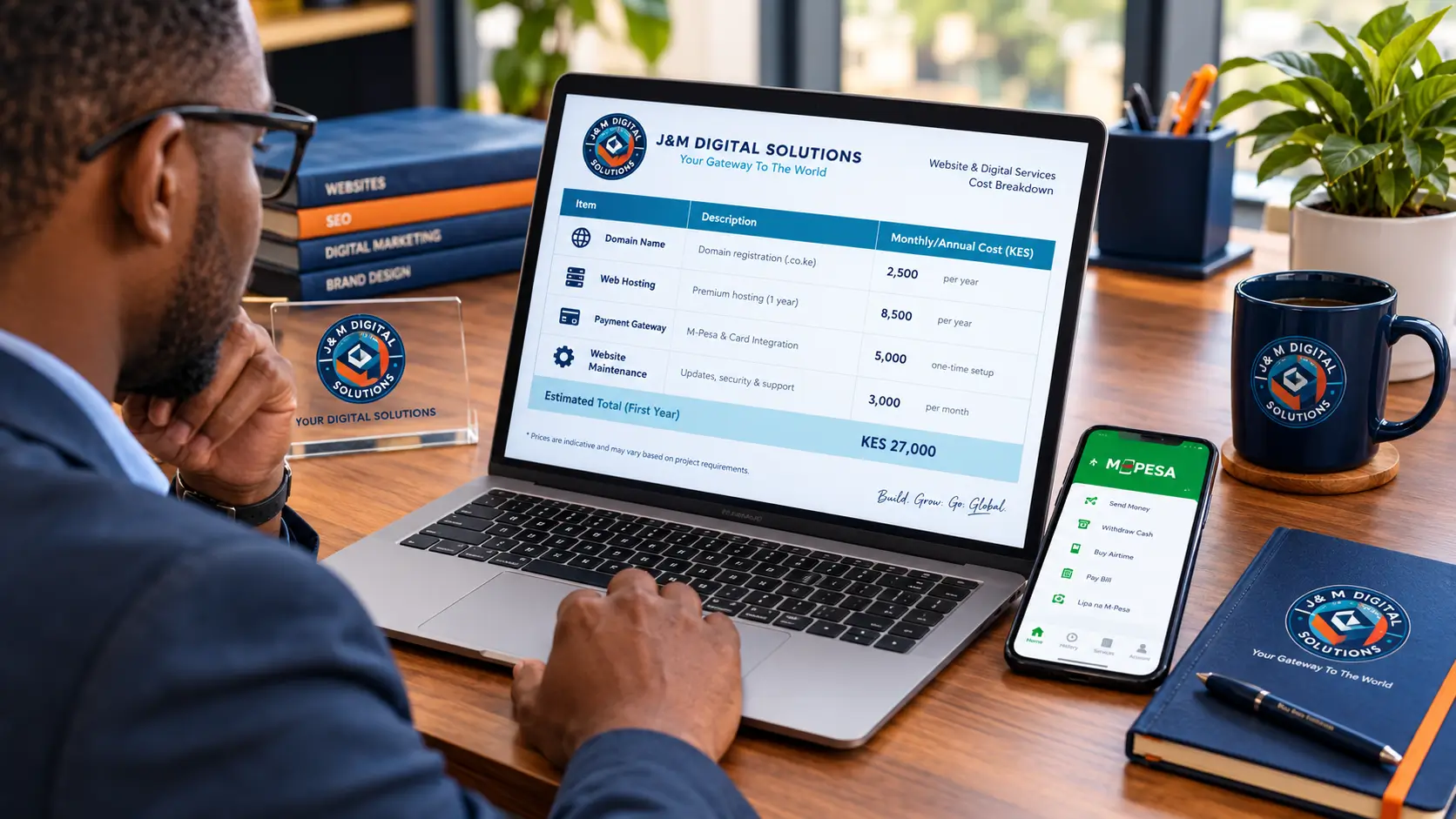
When you search for e-commerce website cost in Kenya, most pricing guides quote one number for “building an online store” and leave it there. That number usually covers design and development only. It rarely includes what you will keep paying every year to keep the store online, or the percentage a payment gateway takes from every single sale you make. A store that looks like a KES 60,000 investment on paper can carry KES 15,000 to 40,000 a year in ongoing costs on top, plus 1 to 3.5 percent of every transaction going to your payment gateway. Understanding every line item before you commit is the only way to compare quotes fairly and avoid budget surprises six months after launch. If you are still deciding whether to sell online at all, our full guide on how to sell products online in Kenya covers platforms, delivery, and getting started, while this guide focuses purely on e-commerce website cost in Kenya.
The Four Real Cost Categories
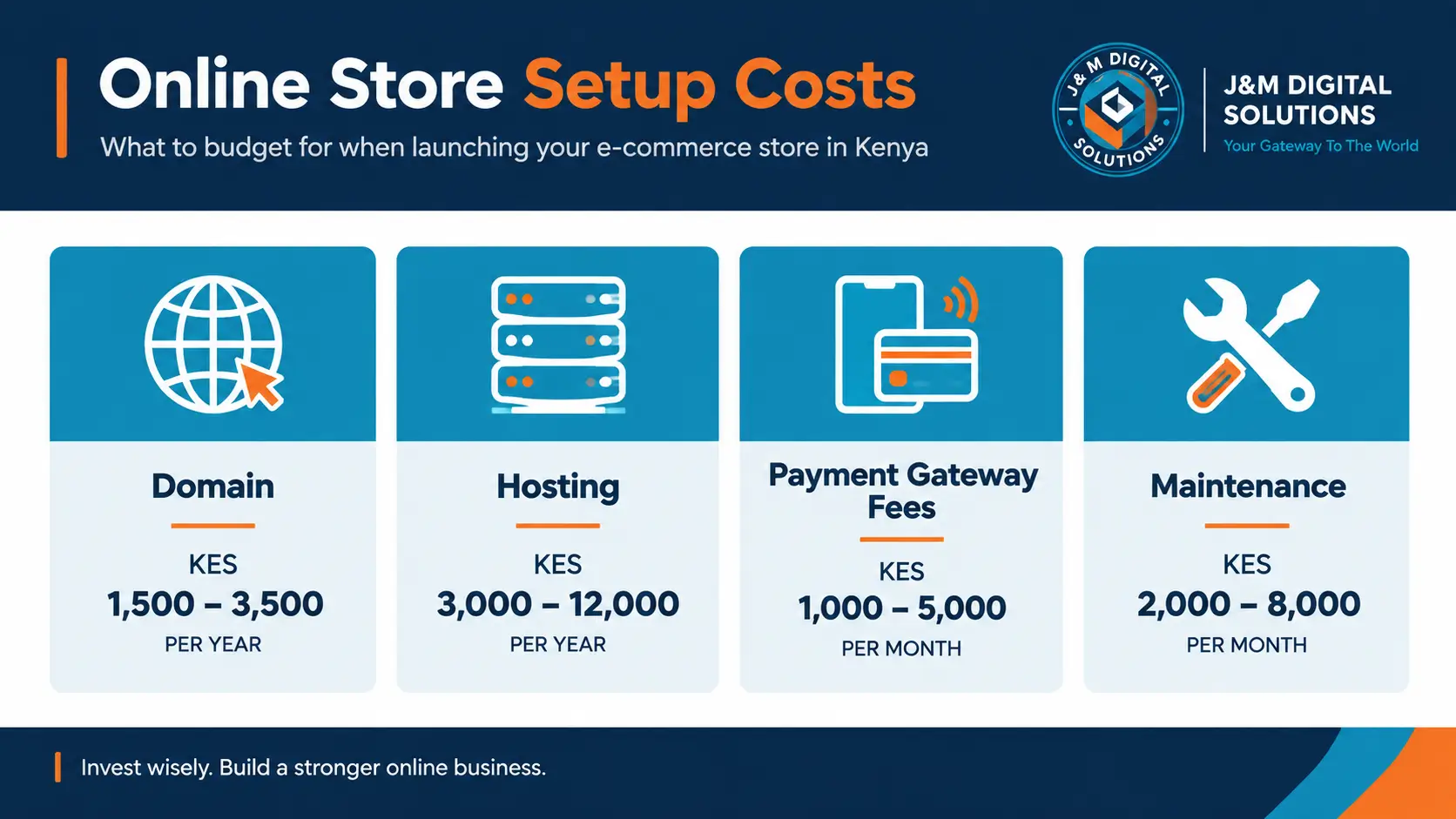
Every itemised e-commerce website cost in Kenya breaks down into four categories: the domain name, hosting, payment gateway fees, and ongoing maintenance. Build cost (design and development) is a separate, one-off line item covered later in this guide. Here is what each of the four recurring categories actually costs in 2026.
1. Domain Registration Cost Kenya
Your domain name is the smallest line item in your overall online store cost Kenya budget, but it is not optional and it renews every year.
| Domain type | Typical cost (KES/year) | Notes |
|---|---|---|
| .co.ke | 900 – 1,500 | Signals a locally based Kenyan business; often prioritised in local search |
| .com | 1,000 – 2,000 | More globally recognised; similar price range to .co.ke |
Whatever domain registration cost Kenya provider you choose, watch for renewal pricing specifically. Some registrars offer a low first-year price that roughly doubles on renewal. Always check the renewal rate before committing, not just the introductory offer.
2. WooCommerce Hosting Cost
WooCommerce hosting cost is where your store’s files, images, and product database actually live. The right tier depends on your product count and expected traffic, not just your budget.
| Hosting tier | Typical cost (KES/year) | Best for |
|---|---|---|
| Basic shared hosting | 2,500 – 6,000 | Starter stores under roughly 50 products, low to moderate traffic |
| Upgraded shared / entry VPS | 10,000 – 40,000 | Growing stores, larger catalogues, higher traffic, faster checkout speed |
3. M-Pesa Payment Gateway Fees
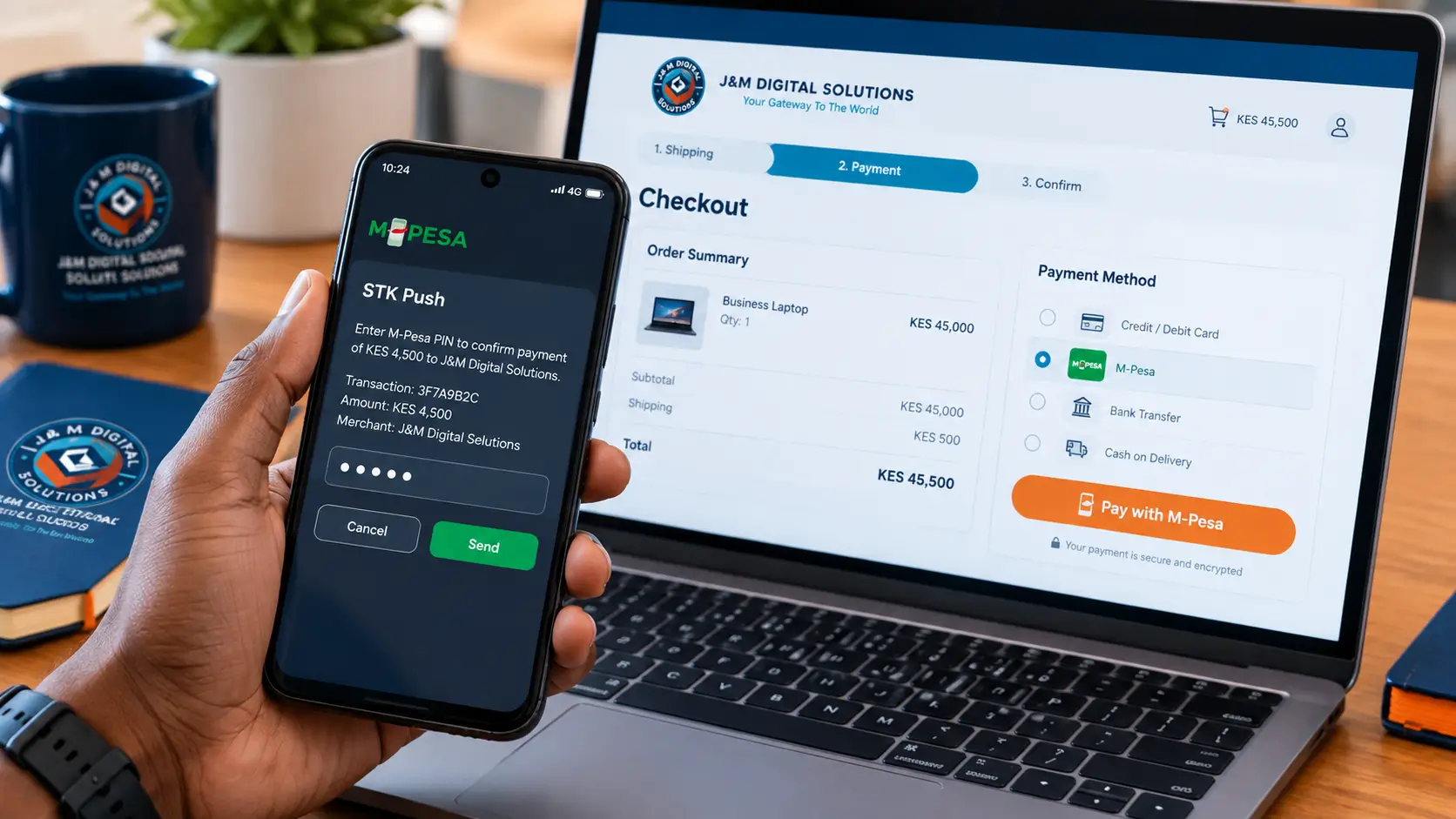
M-Pesa payment gateway fees are the cost most guides skip entirely, and they are often the largest ongoing expense once your store is actually making sales. Every payment gateway takes a percentage of each transaction.
| Payment method | Typical fee | Notes |
|---|---|---|
| Direct M-Pesa Daraja API | 0.5% – 1.5% per transaction | Cheapest option, but requires a developer to set up and maintain the integration directly |
| Pesapal | ~3% – 3.5% per transaction | Most common choice for Kenyan WooCommerce stores; free plugin, covers M-Pesa and cards in one integration |
| Flutterwave | ~1.4% local, ~3.8% international | Better value if you expect customers paying from outside Kenya |
On a store doing KES 200,000 in monthly sales, the difference between a 1% direct M-Pesa fee and a 3.5% aggregator fee is roughly KES 5,000 a month, or KES 60,000 a year. For a Kenya-only store with high sales volume, direct Daraja integration can be worth the extra upfront development cost. For most SMEs starting out, an aggregator like Pesapal is the simpler, faster choice.
4. Website Maintenance Cost Kenya
Website maintenance cost Kenya store owners face is not a one-time purchase. Plugins need updating, security needs monitoring, and payment gateways need re-testing after WordPress core updates.
| Maintenance level | Typical cost (KES/month) | What it usually covers |
|---|---|---|
| Basic | 5,000 – 10,000 | Plugin and core updates, backups, basic security scans |
| Full-service (higher-traffic stores) | 10,000 – 20,000+ | Everything in basic, plus speed optimisation, payment gateway testing after updates, and priority support |
Skipping maintenance entirely is one of the most common ways Kenyan store owners end up with a broken checkout months after launch, usually discovered only when a customer complains that payment is not going through.
Putting It All Together: A Realistic E-Commerce Website Cost in Kenya Budget
Here is what a genuinely itemised first-year cost looks like for a small to mid-sized WooCommerce store in Kenya, separate from the one-off design and development fee.
| Line item | Low estimate (KES) | High estimate (KES) |
|---|---|---|
| Domain (.co.ke, year 1) | 900 | 1,500 |
| Hosting (basic shared, year 1) | 2,500 | 6,000 |
| Payment gateway fees (estimated on KES 100,000/month sales via Pesapal) | 36,000 | 42,000 |
| Maintenance (basic, 12 months) | 60,000 | 120,000 |
Estimated recurring e-commerce website cost in Kenya, first-year total
KES 99,400 – 169,500
on top of your one-off design and development cost
This is the real picture behind any e-commerce website cost in Kenya quote, and why a number that only mentions the build price is incomplete. A KES 60,000 store with no mention of ongoing costs is not actually cheaper than an KES 85,000 store that includes a year of maintenance, once you account for what you would otherwise pay separately.
Common Mistakes When Budgeting for Your Online Store Cost Kenya Plan
| Mistake | Why it hurts you | What to do instead |
|---|---|---|
| Only asking for the build price | You miss hosting, gateway fees, and maintenance, then get surprised by the real annual cost | Ask for an itemised quote covering all four cost categories before committing |
| Choosing the cheapest hosting regardless of catalogue size | Slow checkout on a large catalogue directly increases cart abandonment | Match your hosting tier to your product count and expected traffic |
| Ignoring gateway fee percentages | At scale, a 2 percent fee difference can cost tens of thousands of shillings a year | Calculate gateway fees against your expected monthly sales, not just the headline percentage |
| Skipping maintenance to save money short-term | Unpatched plugins and untested payment gateways are the most common cause of a broken checkout months after launch | Budget for at least basic maintenance from day one, not as an afterthought |
How J&M Digital Solutions Prices E-Commerce Projects
Understanding e-commerce website cost in Kenya starts with a clear quote. We break down every project covering design and development, hosting setup, payment gateway integration, and the first period of post-launch support, so you know exactly what is and is not included before you commit. See our full e-commerce website design in Kenya packages, or read our guide on how to choose the right e-commerce web designer if you are still comparing providers. Based in Nairobi or Kiambu? See our location-specific packages for ecommerce website design in Nairobi or ecommerce website design in Kiambu.
Want an Itemised Quote for Your Online Store?
Send us your product count and requirements on WhatsApp, and we will give you a clear, honest breakdown covering build cost, hosting, payment gateway setup, and ongoing maintenance, no vague one-line quotes.
Chat on WhatsAppFrequently Asked Questions About E-Commerce Website Cost in Kenya
How much does an online store cost in Kenya overall?
Total online store cost Kenya businesses should budget for is the one-off design and build cost, typically ranging from KES 60,000 to 350,000 depending on complexity, plus roughly KES 99,000 to 170,000 in recurring first-year costs covering domain, hosting, payment gateway fees, and maintenance, as broken down in this guide.
What is the cheapest way to accept payments on a Kenyan online store?
Direct M-Pesa Daraja API integration has the lowest transaction fees, typically 0.5 to 1.5 percent, but requires developer setup. For most SMEs, an aggregator like Pesapal at around 3 to 3.5 percent is the simpler starting point, with the option to move to direct Daraja integration once sales volume justifies the extra development cost.
Do I really need to budget for website maintenance cost Kenya providers charge?
Yes. WordPress and WooCommerce require regular plugin and core updates, and payment gateways need re-testing after major updates. Skipping maintenance is one of the most common causes of a broken checkout discovered only when a customer complains that payment failed.
Why do different websites quote different e-commerce website cost in Kenya figures for the same type of store?
E-commerce website cost in Kenya figures vary based on what is included in the quote. A number that only covers design and development will look cheaper than one that bundles in hosting setup, payment gateway integration, and a support period, even if the underlying build is similar. Always ask what is included before comparing two numbers directly.
Does hosting really affect my sales?
Yes. Slow page loads and slow checkout directly increase cart abandonment, particularly on mobile data connections common across Kenya. A store with a large product catalogue on basic shared hosting will convert worse than the same store on an appropriately sized hosting plan.